
Last reviewed: 12 November 2026
Industrial energy efficiency rarely makes headlines in the carbon market, yet it is often among the lower-cost sources of real reductions. India’s Carbon Credit Trading Scheme now has a domestic methodology for it, which gives plant owners outside the compliance mechanism a way to monetise efficiency projects in rupees. The rules, however, are strict about what counts and who can claim it.
The methodology
BM IN02.001, Energy efficiency and fuel switching measures for industrial facilities, was published by the Bureau of Energy Efficiency (BEE) on 27 March 2025 as one of the first approved methodologies under the CCTS offset mechanism. Its scope covers energy efficiency measures at one or several industrial, mining or mineral production facilities. Typical projects include efficient motors, pumps and boilers, and process measures in operations such as furnaces and paper drying. Fuel switching is covered where it is an integral part of an efficiency package, for example moving from steam or compressed air to electricity. The scope wording closely follows the long-established CDM small-scale methodology AMS-II.D.
Who can use it
The offset mechanism is for non-obligated entities. A plant that already has a greenhouse gas emission intensity target under the compliance mechanism is rewarded for efficiency through its target: beating it earns Carbon Credit Certificates directly. Allowing the same plant to claim offset credits for the same savings would count the reduction twice. Where an obligated group wants to participate in the offset mechanism, BEE has indicated at stakeholder workshops that it must do so through a separate non-obligated entity; the formal procedure should be checked before any structure is set up.
What makes or breaks an efficiency project
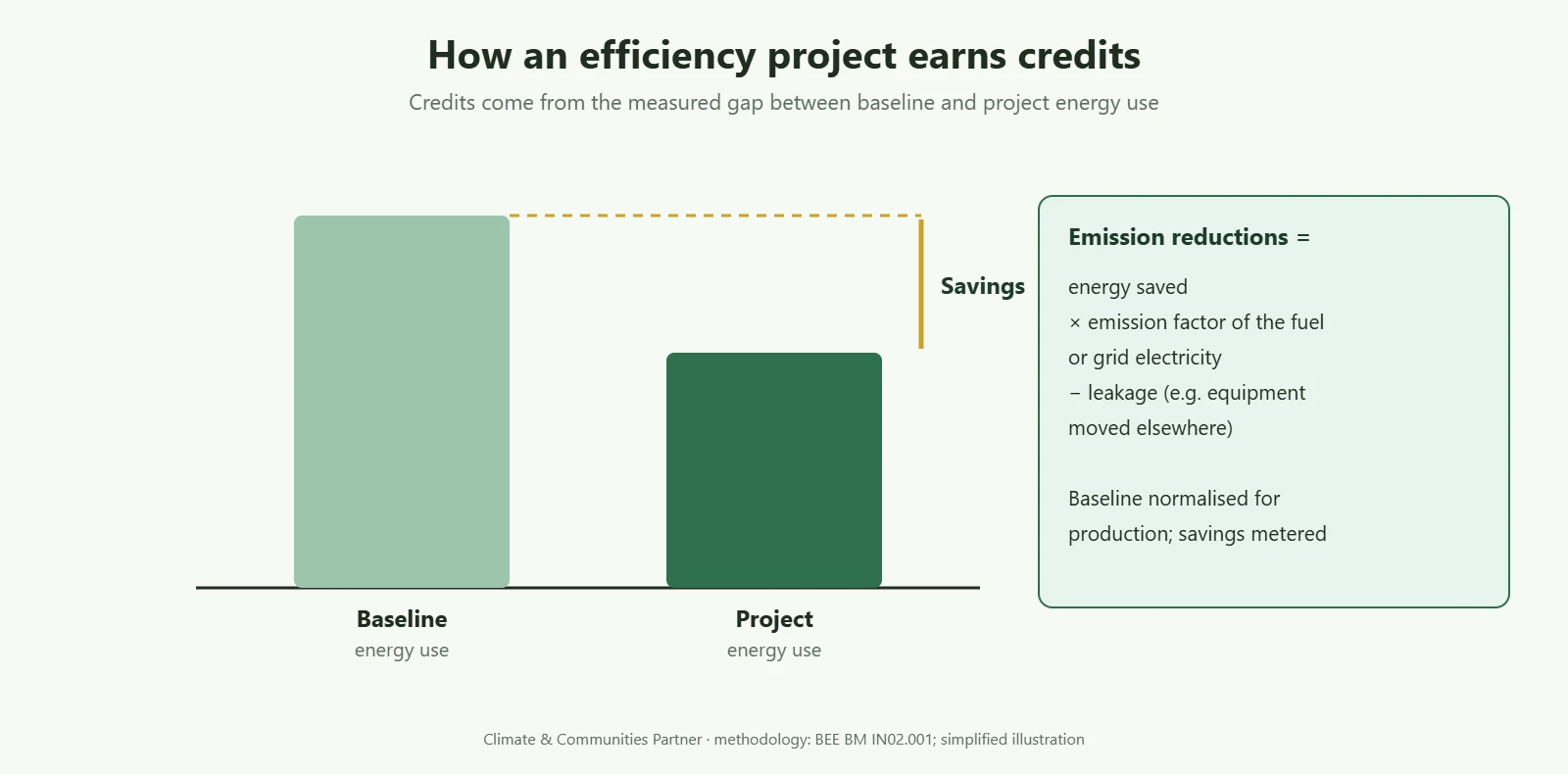
- Baseline energy use. Savings are measured against what the equipment or process would have consumed. That needs metered historical data, normalised for production levels.
- Measurement. Sub-metering of the affected equipment is usually decisive. Estimates based on nameplate ratings rarely survive verification.
- Interaction between measures. Where several measures are installed together, their savings overlap and must be accounted for jointly.
- Equipment leaving the boundary. If replaced equipment is moved and used elsewhere, methodologies of this type require the resulting emissions to be considered as leakage.
- Additionality. Many efficiency measures pay for themselves. Projects need to show why carbon revenue makes the difference, which is easiest for higher-cost measures.
Beyond the domestic route
High-end energy-efficiency technology is also on India’s list of activities eligible for international transfer under Article 6.2. For advanced technologies, an authorised international route — for example through the Joint Crediting Mechanism with Japan — may command more value than a domestic certificate, at the cost of a longer approval process.
Climate & Communities Partner advises industrial clients on efficiency and fuel-switch projects under the CCTS offset mechanism and Article 6.
Sources
- Bureau of Energy Efficiency – BM IN02.001 Energy efficiency and fuel switching measures for industrial facilities and approved methodologies list
- UNFCCC – CDM AMS-II.D
- CLII – Indian Carbon Market workshop debrief
- Ministry of Environment, Government of Japan – Eligible activities in India under Article 6.2