Last reviewed: 12 November 2026
Article 6 of the Paris Agreement lets countries cooperate on their climate targets by transferring mitigation outcomes between them. For a project developer it changes one thing above all: a credit’s value can now depend on a government decision to authorise it. This note explains the two market routes, what has actually happened in 2026, and what India has opened up.
Two routes, one accounting principle
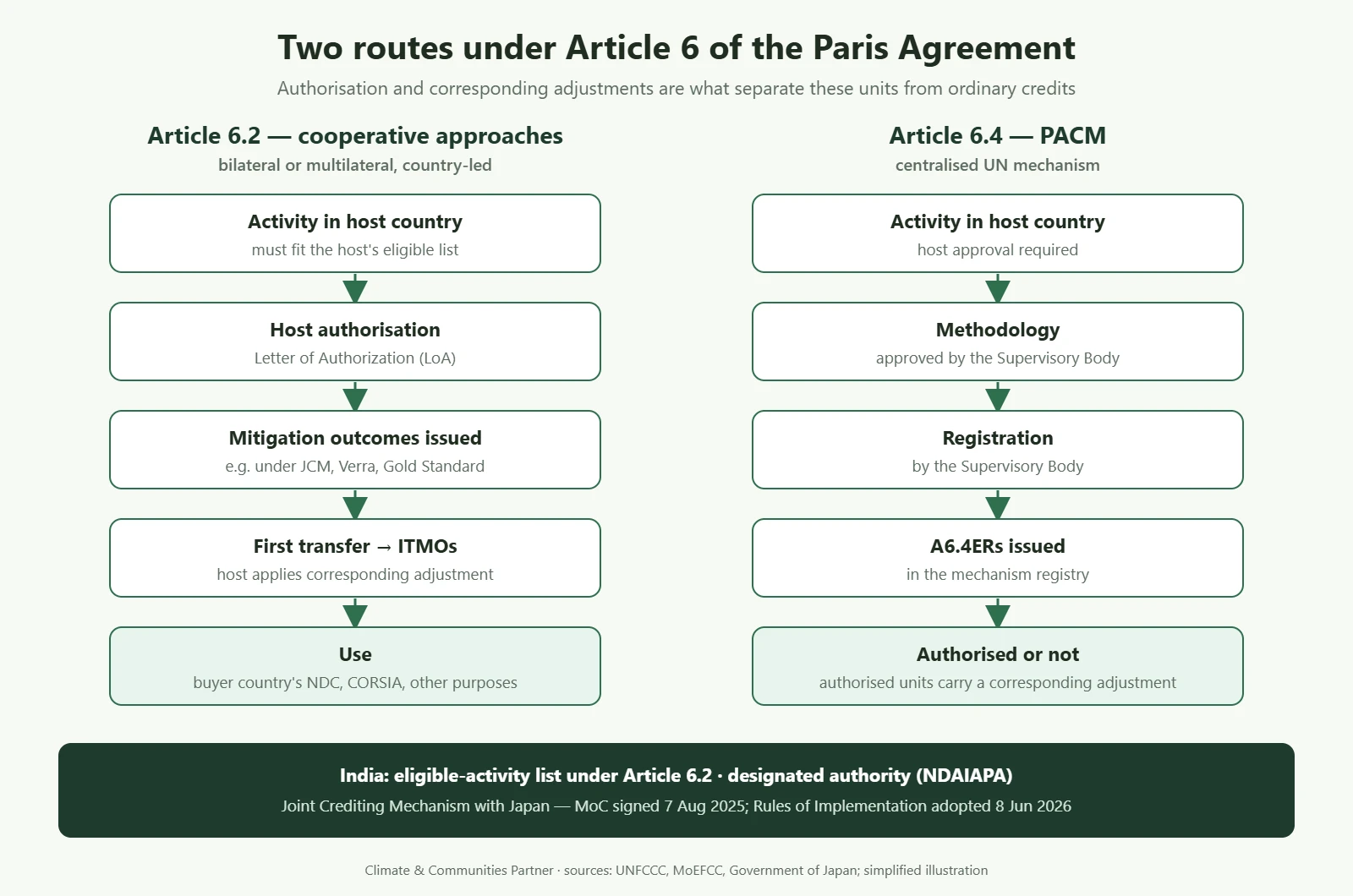
Article 6.2 – cooperative approaches. Countries agree bilaterally (or in small groups) to transfer mitigation outcomes. When an outcome is authorised by the host country and first transferred, it becomes an internationally transferred mitigation outcome (ITMO), and the host applies a corresponding adjustment: it adds the transferred tonnes back to its own emissions balance so that the same reduction is not counted twice. Authorised outcomes can be used towards another country’s nationally determined contribution (NDC), for CORSIA, or for other international purposes.
Article 6.4 – the Paris Agreement Crediting Mechanism (PACM). A centralised mechanism under UN supervision and the successor to the Kyoto Protocol’s Clean Development Mechanism (CDM). Its Supervisory Body approves methodologies, registers activities and issues units (A6.4ERs) in the mechanism registry. Units may be authorised, in which case a corresponding adjustment follows, or remain unauthorised.
What happened in 2026
The first PACM credits. On 26 February 2026 the UN approved the first issuance under Article 6.4, for a clean-cooking project in Myanmar coordinated with authorised participants from the Republic of Korea. Because updated values and more conservative calculations were applied, the credited reductions were about 40 percent lower than the same project would have received under the CDM. That is the clearest signal yet of how the mechanism intends to treat legacy activities.
The CDM transition narrowed. At COP30 the parties extended the deadline for host governments to approve the transition of CDM activities to 30 June 2026. By that date, host approval had been obtained for 418 CDM projects and programmes, out of more than 1,500 that had requested transition. Market reporting attributes much of the shortfall to large host countries, including India, not approving most of their transition requests. For Indian CDM-era projects, the PACM route is therefore largely closed.
India’s Article 6 framework
India notified a National Designated Authority for the Implementation of the Paris Agreement (NDAIAPA) in May 2022. The government has since published a list of activities it will consider for trading under Article 6.2. The government’s stated aim is to use Article 6.2 to bring in emerging technologies and international finance, and the list reflects that. It includes:
- renewable energy with storage (stored component only), solar thermal power and offshore wind;
- green hydrogen and compressed biogas;
- emerging mobility solutions such as fuel cells, and high-end energy-efficiency technology;
- sustainable aviation fuel and alternate materials such as green ammonia;
- removal activities, including carbon capture, utilisation and storage.
The first bilateral channel is the Joint Crediting Mechanism (JCM) with Japan. The two governments signed a Memorandum of Cooperation on 7 August 2025, and the Joint Committee adopted the Rules of Implementation on 8 June 2026. Under the rules, a project must align with India’s Article 6.2 activity list; Japanese participants register on the Indian Carbon Market portal to receive a Letter of Authorization; and the Government of India applies corresponding adjustments to authorised JCM credits. A joint Operational Manual, launched in New Delhi at the end of September 2026, sets out the full project cycle from Project Idea Note to issuance and authorisation of credits, including project-specific allocation of credits between the two sides.
What a developer should check
- Is the activity on the host’s list? In India, an activity outside the Article 6.2 list is not eligible for authorisation under the current framework, however strong the project.
- What exactly does the Letter of Authorization say? The authorised uses, the volume and vintages, and how “first transfer” is defined all determine when the corresponding adjustment is applied and what a buyer can claim.
- Which programme will issue the units? JCM, PACM or an independent standard with Article 6 labelling. Gold Standard, for example, can only label credits from reductions achieved from 2021 onwards as authorised.
- Who carries authorisation risk? Offtake contracts should state what happens if authorisation is delayed, revised or a corresponding adjustment is not applied.
- Is a domestic route better? For many Indian activities the Carbon Credit Trading Scheme’s offset mechanism may be the more realistic market.
Climate & Communities Partner advises on Article 6 eligibility, authorisation and the structuring of authorised credit transactions.
Sources
- UNFCCC – UN carbon market approves first-ever issuance of credits under the Paris Agreement (26 February 2026)
- UNFCCC – Annual report of the Article 6.4 Supervisory Body to the CMA (2026) and CDM transition FAQs
- Climate Home News – CDM credits locked out after China and India decisions (17 July 2026)
- Ministry of Environment, Government of Japan – JCM developments and eligible activities in India; MoEFCC – Rules of Implementation of the JCM; Ministry of the Environment, Japan – India–Japan JCM Operational Manual
- Gold Standard – Article 6 and CORSIA labelling guide