Forest fires in the Western Himalaya: what is being lost and what would help

Last reviewed: 16 November 2026

Uttarakhand’s official forest fire season runs from 15 February to 15 June. Every year, forest department teams prepare for it by cleaning fire lines, cutting grass and bushes, and carrying out controlled burning. That groundwork matters more each year.

What the recent record shows

Forest Survey of India (FSI) satellites recorded 21,033 fire counts in Uttarakhand from November 2023 to June 2024, up from 5,351 a year earlier. In Himachal Pradesh, the count rose from 704 to 10,136 over the same two seasons. In 2024, forest fires killed 12 people in Uttarakhand.
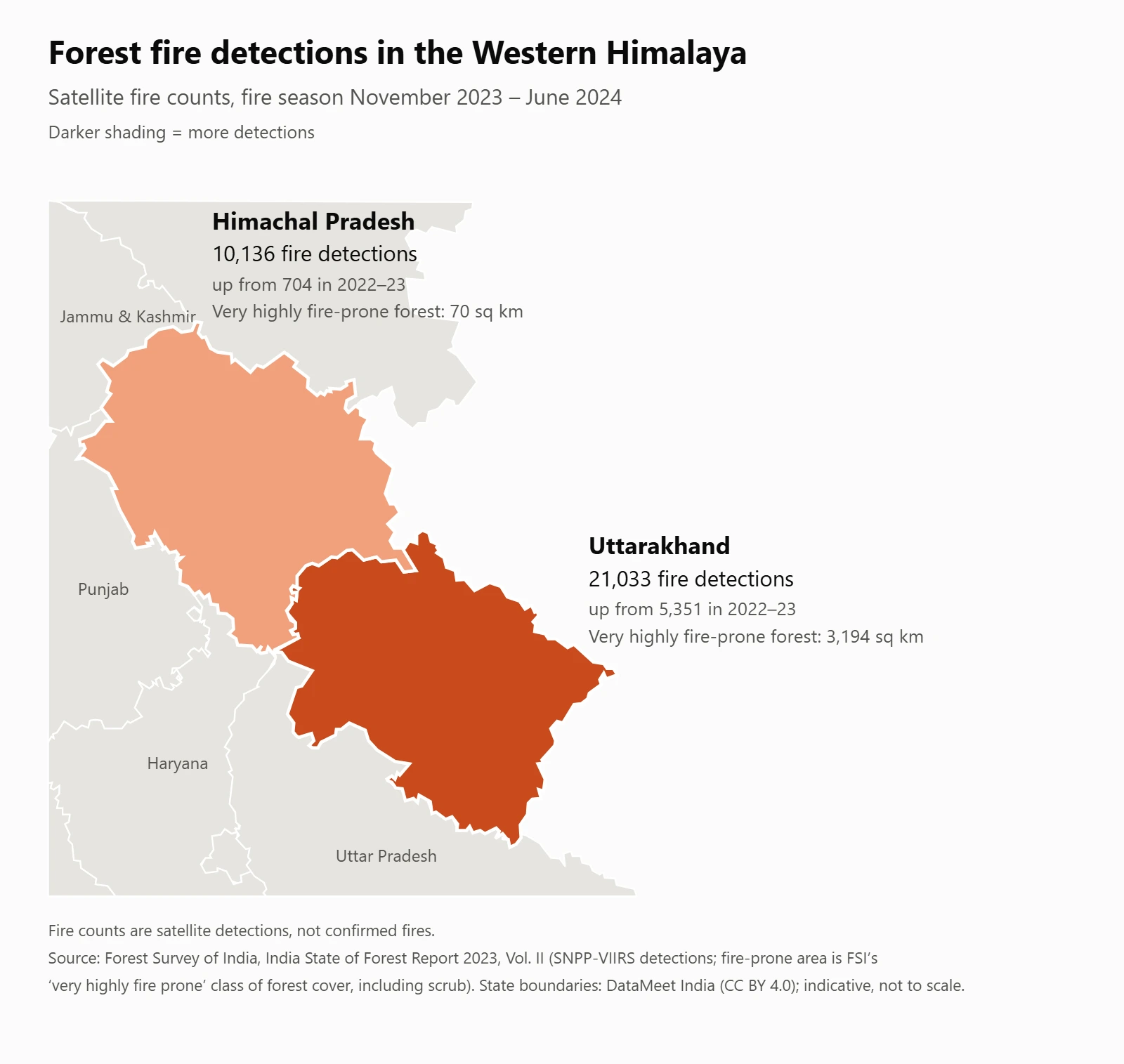
Satellite forest fire detections in Himachal Pradesh and Uttarakhand, fire season 2023–24
Satellite fire detections in Himachal Pradesh and Uttarakhand, November 2023 to June 2024. Detections are not confirmed fires.

What gets lost

  • Wildlife. Cheer pheasant, kalij pheasant and Himalayan monal breed from April to June, in the middle of the fire season. The cheer pheasant nests on the ground in dense bushes. Reptiles and mammals cannot escape flames as quickly as birds, and butterfly larvae burn along with their host plants.
  • Forest. Frequent fires favour chir pine over broadleaf oak. Chir pine already accounts for nearly 57% of fire incidents in the Western Himalaya. In fire-prone Uttarakhand forests, researchers found fire-tolerant species becoming more dominant where fires are frequent, and warned that tree diversity could decline.
  • Soil. Research in Uttarakhand found that fires cut soil organic carbon by an average of 35%, nitrogen by 25% and phosphorus by 15%.
  • Glaciers. An ICIMOD scientist estimated in 2020 that 30–40% of the black carbon deposited in the Himalaya in April and May comes from forest fires.

Field teams need better data

In August 2026, a parliamentary committee reported that only about 12.5% of FSI fire alerts in Uttarakhand corresponded to actual fires. It recommended structured training to help nodal officers interpret and prioritise alerts. Sharper alerts and shared, ground-verified data would let field teams focus on real fires and strengthen the case for prevention funding.

What would help

  1. Back the pre-season work on fire lines and fuel clearance before 15 February.
  2. Pay the communities who work alongside the forest department on prevention.
  3. Give prevention reliable funding. The central Forest Fire Prevention and Management scheme ended in 2025-26 and is under review.
  4. Build one ground-verified burnt-area dataset that departments, funders and researchers can all use.
  5. Give forest biomass a value. When material cleared from the forest floor can become biochar, boards or fuels, removing it before the fire season has an income attached.

Climate & Communities Partner is working on value addition from forest biomass, including biochar, boards and fuels.

If you work on this problem, we would like to hear from you. That includes forest departments, Van Panchayats, funders, and companies with Himalayan supply chains or nature-based carbon exposure. Contact Climate & Communities Partner.

Sources

India’s Carbon Credit Trading Scheme: where it stands in November 2026

Last reviewed: 12 November 2026

India’s Carbon Credit Trading Scheme (CCTS) has moved from notification to obligation. Industrial plants in seven sectors have legally binding emission-intensity targets, the offset rulebook is in place, and the trading rules have been written. What has not yet happened is the first trade. This note sets out where the scheme stands, and what it means for obligated companies and for project developers.

The architecture

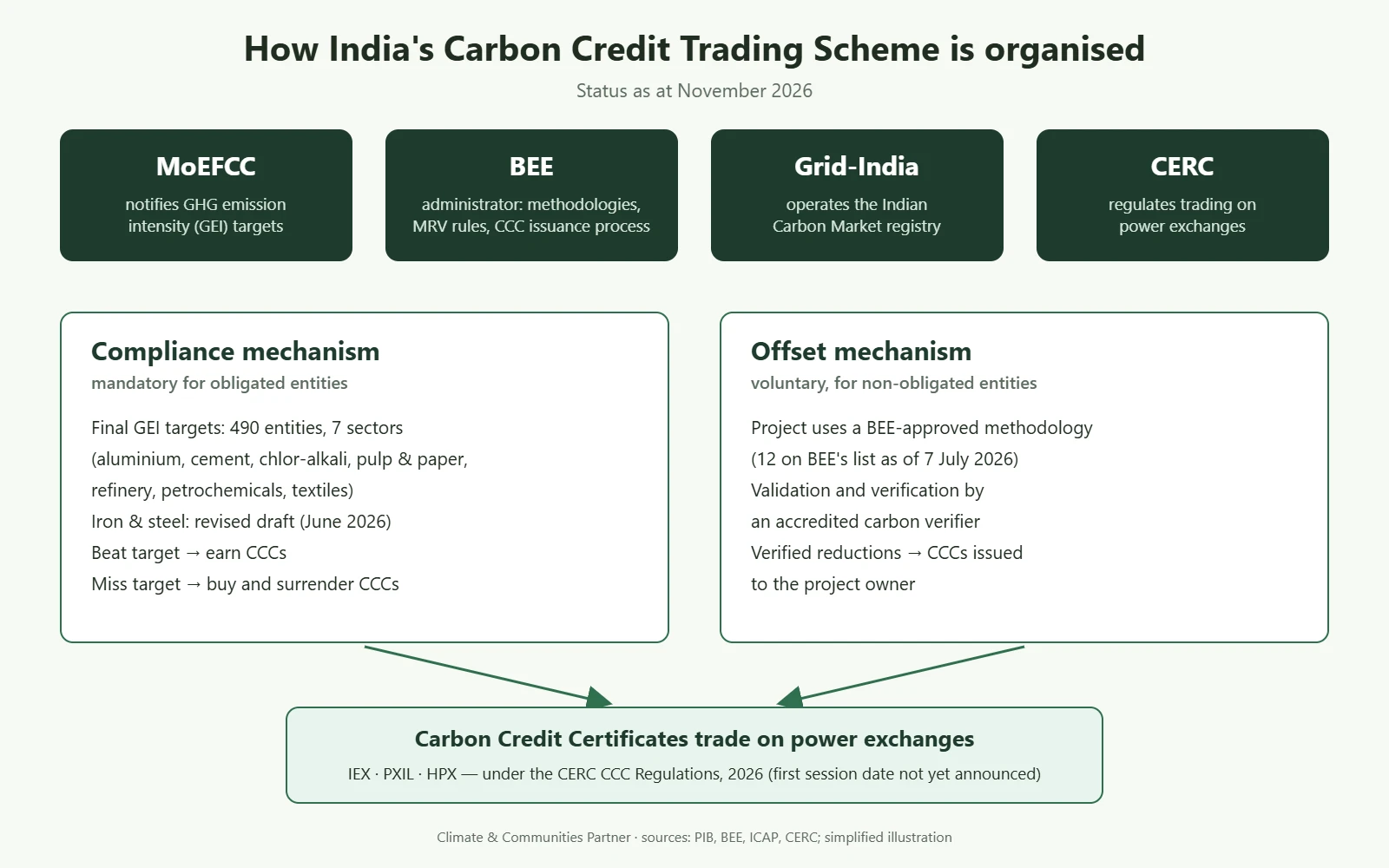
The scheme was notified in June 2023 under the Energy Conservation (Amendment) Act, 2022, and amended in December 2023 to add an offset mechanism. It operates through two mechanisms. Under the compliance mechanism, emission-intensive industries are designated as obligated entities and given greenhouse gas emission intensity (GEI) targets: tonnes of CO2e per unit of output, not an absolute cap. Entities that outperform their targets receive Carbon Credit Certificates (CCCs); entities that fall short must buy and surrender them. Under the offset mechanism, non-obligated entities can register projects that reduce, avoid or remove emissions and receive CCCs for verified results.

Institutions and mechanisms of India's Carbon Credit Trading Scheme
Institutions and mechanisms under the CCTS, as at November 2026.

Who is covered today

Final GEI targets were notified in two rounds. In October 2025 the government notified targets for aluminium, cement, chlor-alkali and pulp & paper, covering 282 obligated entities. In January 2026 it added refinery, petrochemicals, textiles and secondary aluminium, bringing the total to 490 obligated entities. Targets were set for compliance years 2025–26 and 2026–27, with 2023–24 as the baseline year. The list is already moving: an amendment dated 7 September 2026, reported by Business Standard in November, withdrew the 2025–26 targets for the refinery and textile sectors, while their 2026–27 targets remain in place.

Iron and steel, the largest prospective addition, is not yet final. A revised draft notification dated 26 June 2026 proposes targets for 255 units for 2026–27 only, leaving the 2025–26 column blank. Fertilisers, also named as a CCTS sector, do not yet have final targets.

Trading: rules written, first session pending

The Central Electricity Regulatory Commission (CERC) notified its regulations for the purchase and sale of CCCs on 27 February 2026. CCCs will trade only on CERC-registered power exchanges — IEX, PXIL and HPX — within a floor and a forbearance (ceiling) price approved by CERC. In October 2026 the Bureau of Energy Efficiency (BEE) issued a detailed procedure for CCC transactions: sessions on the last Thursday of each month, with prices discovered through a uniform-price auction. As at the date of this note, we have not seen a published floor or ceiling price or a confirmed date for the first session; trading also depends on the first issuance of certificates following verification of 2025–26 performance. An entity that does not surrender enough certificates faces environmental compensation of twice the average CCC price traded during the compliance year.

The offset mechanism: twelve methodologies, and notable gaps

BEE’s list of approved offset methodologies, last updated on 7 July 2026, contains twelve methodologies:

Sector Approved methodologies
Energy Grid-connected renewable electricity; hydrogen from electrolysis of water; electricity and heat from biomass
Industries Energy efficiency and fuel switching at industrial facilities; hydrogen from biogas methane
Waste Landfill methane recovery; flaring or use of landfill gas; compressed biogas (CBG) production
Agriculture Methane recovery from livestock and manure at households and small farms; improved management practices in rice cultivation
Forestry Afforestation and reforestation of degraded mangrove habitats; afforestation and reforestation of lands except wetlands

The gaps matter as much as the list. When BEE approved sectors for the offset mechanism in 2024, its indicative activities included biochar and agroforestry. Neither has an approved CCTS methodology yet. A biochar or agroforestry developer in India therefore still has to look to international standards, or wait.

What this means in practice

For obligated entities, the binding constraint is verified data. Each plant’s position against its target determines whether it holds surplus certificates or a shortfall, and banking of CCCs is permitted, so surplus holders have no obligation to sell in the first session. Compliance planning should rest on verified intensity figures, not on expected market prices, until the first price is actually discovered.

For project developers, the CCTS offset route is now a real alternative to the voluntary market for activities that have an approved BEE methodology, such as CBG, improved rice management or industrial energy efficiency. The choice between a domestic CCC, an international voluntary credit and an Article 6.2-authorised credit depends on the methodology available, who the buyer is, and whether the activity can be authorised for export.

Climate & Communities Partner advises obligated entities and project developers on the CCTS compliance and offset mechanisms, and on choosing between domestic and international routes.

Sources

Article 6 in practice: authorisation, corresponding adjustments and India’s opening

Last reviewed: 12 November 2026

Article 6 of the Paris Agreement lets countries cooperate on their climate targets by transferring mitigation outcomes between them. For a project developer it changes one thing above all: a credit’s value can now depend on a government decision to authorise it. This note explains the two market routes, what has actually happened in 2026, and what India has opened up.

Two routes, one accounting principle

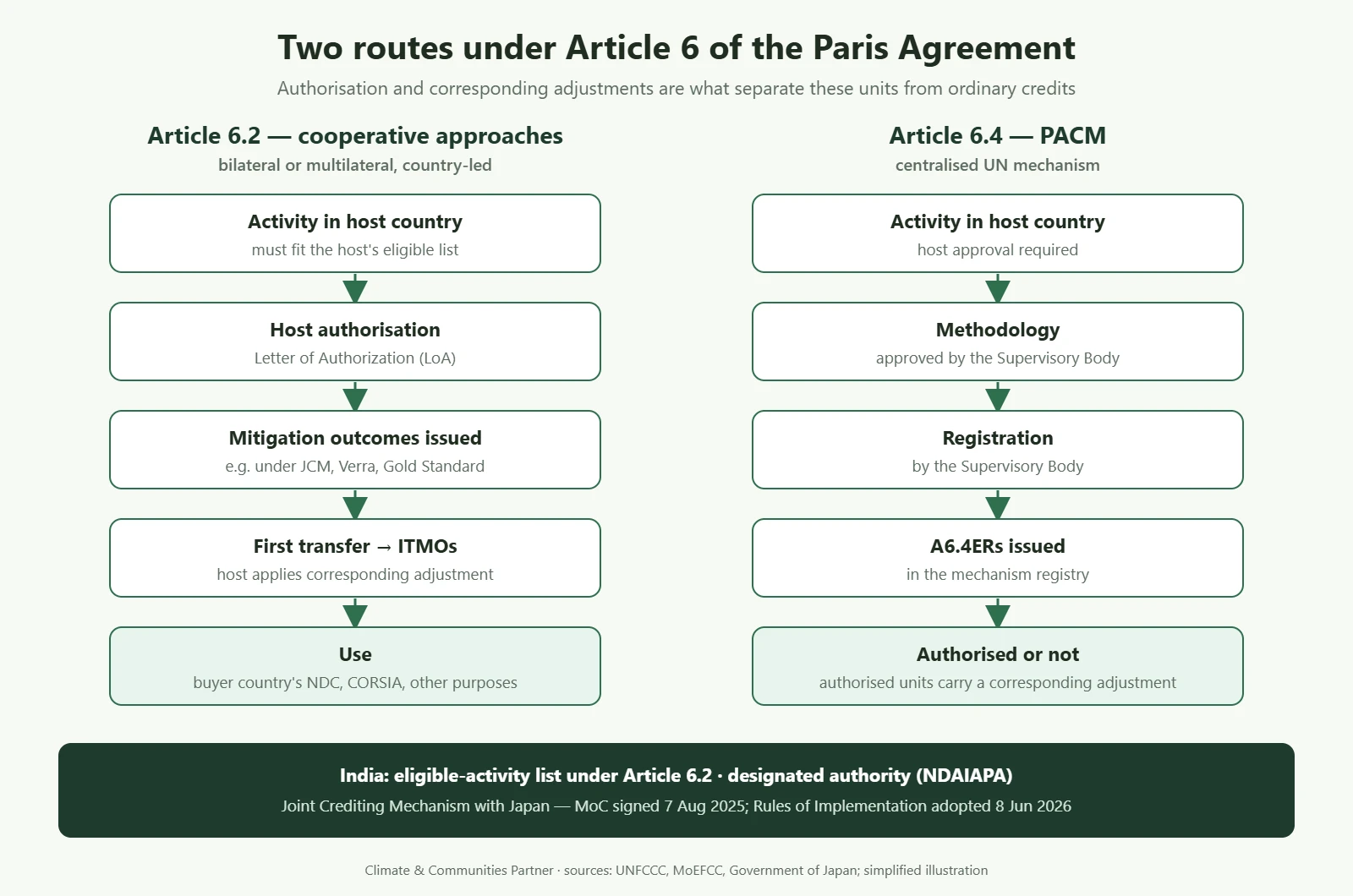
Article 6.2 – cooperative approaches. Countries agree bilaterally (or in small groups) to transfer mitigation outcomes. When an outcome is authorised by the host country and first transferred, it becomes an internationally transferred mitigation outcome (ITMO), and the host applies a corresponding adjustment: it adds the transferred tonnes back to its own emissions balance so that the same reduction is not counted twice. Authorised outcomes can be used towards another country’s nationally determined contribution (NDC), for CORSIA, or for other international purposes.

Article 6.4 – the Paris Agreement Crediting Mechanism (PACM). A centralised mechanism under UN supervision and the successor to the Kyoto Protocol’s Clean Development Mechanism (CDM). Its Supervisory Body approves methodologies, registers activities and issues units (A6.4ERs) in the mechanism registry. Units may be authorised, in which case a corresponding adjustment follows, or remain unauthorised.

Article 6.2 and Article 6.4 routes
The Article 6.2 and Article 6.4 routes, and India’s current framework.

What happened in 2026

The first PACM credits. On 26 February 2026 the UN approved the first issuance under Article 6.4, for a clean-cooking project in Myanmar coordinated with authorised participants from the Republic of Korea. Because updated values and more conservative calculations were applied, the credited reductions were about 40 percent lower than the same project would have received under the CDM. That is the clearest signal yet of how the mechanism intends to treat legacy activities.

The CDM transition narrowed. At COP30 the parties extended the deadline for host governments to approve the transition of CDM activities to 30 June 2026. By that date, host approval had been obtained for 418 CDM projects and programmes, out of more than 1,500 that had requested transition. Market reporting attributes much of the shortfall to large host countries, including India, not approving most of their transition requests. For Indian CDM-era projects, the PACM route is therefore largely closed.

India’s Article 6 framework

India notified a National Designated Authority for the Implementation of the Paris Agreement (NDAIAPA) in May 2022. The government has since published a list of activities it will consider for trading under Article 6.2. The government’s stated aim is to use Article 6.2 to bring in emerging technologies and international finance, and the list reflects that. It includes:

  • renewable energy with storage (stored component only), solar thermal power and offshore wind;
  • green hydrogen and compressed biogas;
  • emerging mobility solutions such as fuel cells, and high-end energy-efficiency technology;
  • sustainable aviation fuel and alternate materials such as green ammonia;
  • removal activities, including carbon capture, utilisation and storage.

The first bilateral channel is the Joint Crediting Mechanism (JCM) with Japan. The two governments signed a Memorandum of Cooperation on 7 August 2025, and the Joint Committee adopted the Rules of Implementation on 8 June 2026. Under the rules, a project must align with India’s Article 6.2 activity list; Japanese participants register on the Indian Carbon Market portal to receive a Letter of Authorization; and the Government of India applies corresponding adjustments to authorised JCM credits. A joint Operational Manual, launched in New Delhi at the end of September 2026, sets out the full project cycle from Project Idea Note to issuance and authorisation of credits, including project-specific allocation of credits between the two sides.

What a developer should check

  1. Is the activity on the host’s list? In India, an activity outside the Article 6.2 list is not eligible for authorisation under the current framework, however strong the project.
  2. What exactly does the Letter of Authorization say? The authorised uses, the volume and vintages, and how “first transfer” is defined all determine when the corresponding adjustment is applied and what a buyer can claim.
  3. Which programme will issue the units? JCM, PACM or an independent standard with Article 6 labelling. Gold Standard, for example, can only label credits from reductions achieved from 2021 onwards as authorised.
  4. Who carries authorisation risk? Offtake contracts should state what happens if authorisation is delayed, revised or a corresponding adjustment is not applied.
  5. Is a domestic route better? For many Indian activities the Carbon Credit Trading Scheme’s offset mechanism may be the more realistic market.

Climate & Communities Partner advises on Article 6 eligibility, authorisation and the structuring of authorised credit transactions.

Sources

Choosing a carbon standard in 2026: Verra, Gold Standard and what buyers now check

Last reviewed: 12 November 2026

A carbon credit is only as useful as the rulebook behind it. That rulebook is the standard, or crediting programme: it decides which methodologies a project may use, who checks the numbers, how credits are issued and retired, and increasingly whether a credit can travel into compliance markets such as CORSIA or Article 6 of the Paris Agreement. Choosing the standard is one of the first decisions in a project and one of the hardest to reverse.

What a standard actually does

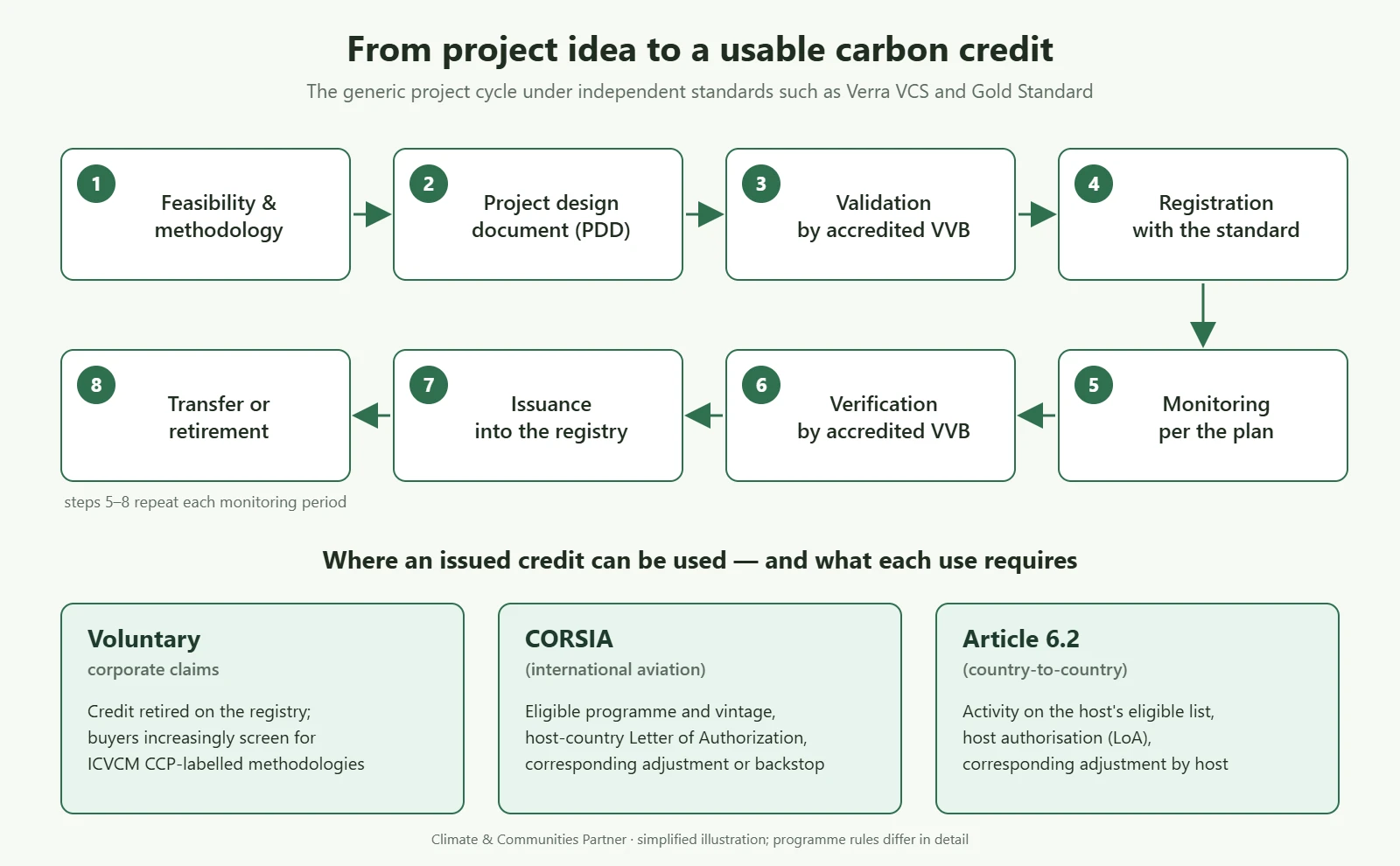
Independent standards share a common architecture. The standard publishes programme rules and approves methodologies. A project applies one methodology, describes itself in a project design document, and is checked by an accredited third party, a validation and verification body (VVB), before registration. After each monitoring period the VVB verifies the reported reductions or removals, and the standard issues credits into its registry, where they can be transferred or retired.

Carbon project cycle and requirements by end use
The generic project cycle, and the extra conditions attached to each end use. Programme rules differ in detail.

The main programmes in 2026

  • Verra – Verified Carbon Standard (VCS). Covers energy, industry, waste, agriculture and land use. Verra released VCS Version 5 on 16 December 2025. In October 2026 it moved the effective date for most Version 5 requirements, including the mandatory new project templates, from 1 January 2027 to 1 July 2027. Projects may adopt Version 5 earlier.
  • Gold Standard for the Global Goals (GS4GG). Widely used for community-scale activities such as clean cooking and household biogas, and certifies sustainable-development outcomes alongside emission reductions. Gold Standard operates a labelling process for credits authorised under Article 6; only reductions and removals achieved from 2021 onwards can be authorised.
  • Other programmes. Global Carbon Council, Isometric and Puro.earth (focused on carbon removal), American Carbon Registry, Climate Action Reserve and ART TREES (jurisdictional forest crediting) each serve specific project types or buyer groups.

The quality layer: ICVCM and the CCP label

The Integrity Council for the Voluntary Carbon Market (ICVCM) does not issue credits. It assesses programmes and methodologies against its Core Carbon Principles. A credit can carry the CCP label only if it comes from a CCP-Approved methodology under a CCP-Eligible programme. The assessments are methodology by methodology, and they have consequences: in 2024 the ICVCM declined to approve the older renewable-energy methodologies, citing additionality; in May 2026 it approved a revised Verra renewable-energy methodology (VMR0017) with conditions. For a developer, the practical question is no longer only “which standard?” but “which methodology version, and does it carry the label buyers screen for?”

Where the credit will be used decides more than it used to

Voluntary corporate use. The credit is retired on the registry against a claim. Buyer due diligence increasingly starts with the CCP label, the methodology version and the project’s monitoring evidence.

CORSIA (international aviation). For the First Phase (2024–2026), eligible units must come from an ICAO-approved programme and an eligible vintage, and carry a host-country Letter of Authorization with either evidence of a corresponding adjustment or a programme backstop. Airlines must retire units for the First Phase by 31 January 2028. According to IATA, ten countries had released eligible units through Letters of Authorization as of April 2026, which is why supply remains tight.

Article 6.2 transfers. The host government authorises the mitigation outcome and applies a corresponding adjustment. The independent standard still issues and tracks the credit, but its value now depends on a sovereign decision as much as on the methodology.

A practical checklist before choosing

  1. Methodology fit. Is there an active methodology for the activity under this programme, and which version applies after the programme’s next effective date?
  2. Label status. Is that methodology CCP-Approved, conditionally approved, or not yet assessed?
  3. End market. Voluntary, CORSIA, Article 6.2 or a domestic scheme? Each adds conditions, and some (authorisation, corresponding adjustment) sit outside the developer’s control.
  4. Host-country position. For India, check whether the activity is on the government’s Article 6.2 list and whether a domestic route under the Carbon Credit Trading Scheme is more suitable.
  5. Cost and time. Registration and issuance fees, VVB availability and review timelines differ by programme and should be in the financial model from day one.

Climate & Communities Partner advises project developers on standard and methodology selection, project documentation and the authorisation questions that now sit alongside them.

Sources

EU CBAM and India’s carbon market: what exporters of steel, aluminium and cement need to know

Last reviewed: 12 November 2026

Since 1 January 2026, the European Union has been putting a price on the carbon embedded in imported steel, aluminium, cement, fertilisers, hydrogen and electricity. India’s own carbon market, meanwhile, has targets but no traded price yet. For Indian exporters in these sectors, the gap between the two systems is now a cost line.

How CBAM works in its definitive phase

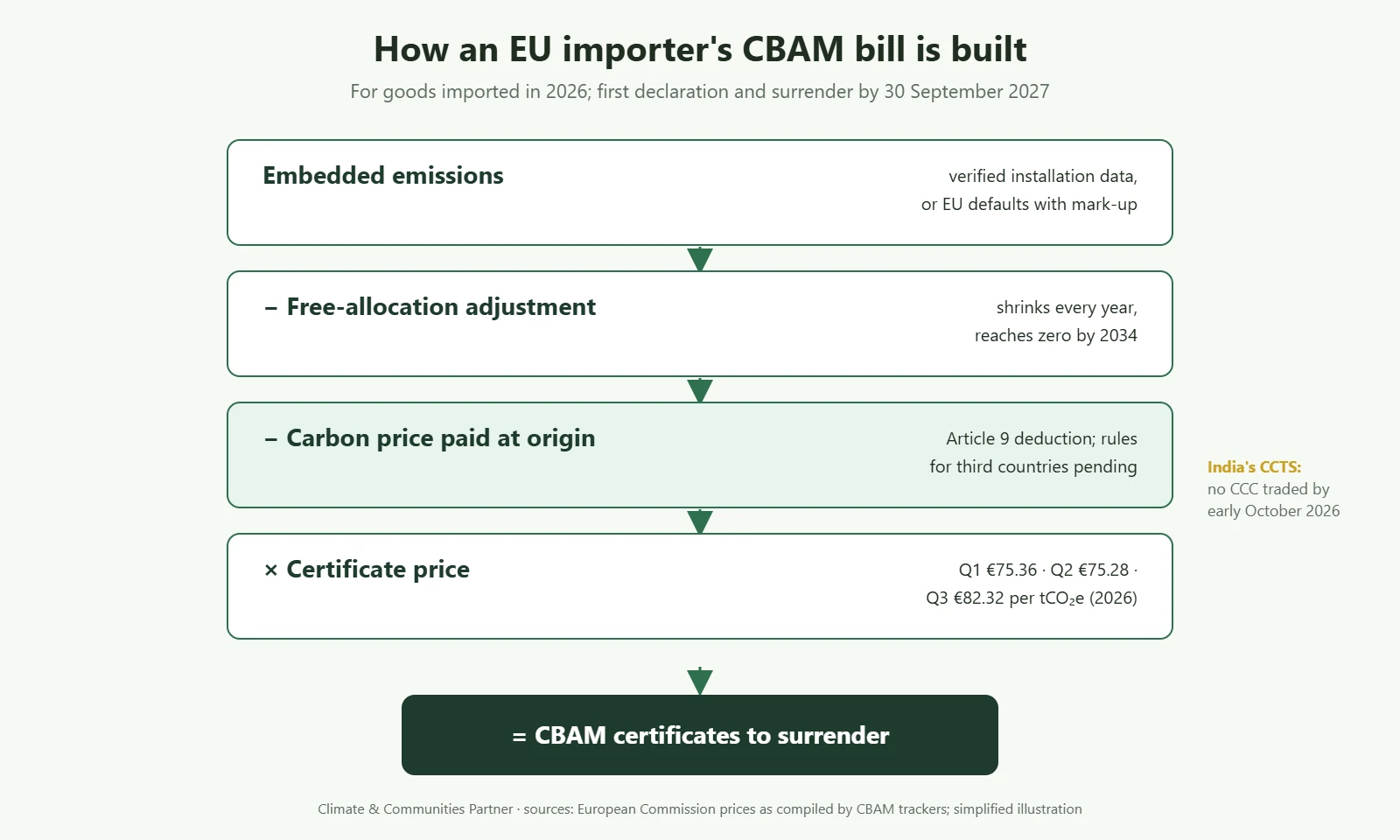
The Carbon Border Adjustment Mechanism moved from reporting-only to its definitive phase on 1 January 2026. EU importers of covered goods, acting as authorised CBAM declarants, must declare the embedded emissions of what they import and surrender CBAM certificates to cover them. For 2026 imports, the European Commission publishes a quarterly certificate price based on EU Emissions Trading System auctions: €75.36 per tonne for Q1, €75.28 for Q2 and €82.32 for Q3. Certificate sales open on 1 February 2027, and the first annual declaration and surrender, covering 2026 imports, is due by 30 September 2027.

How an EU importer's CBAM bill is built
How an EU importer’s CBAM liability is built up, and where the Indian producer’s data and carbon price enter.

Three numbers that drive the bill

  1. Embedded emissions. Verified, installation-level data from the producer, or EU default values if no data is supplied. Default values include a mark-up that rises each year to 2028, so missing data is expensive.
  2. The free-allocation adjustment. Certificates owed are reduced to reflect free allocation still given to EU producers. That adjustment shrinks each year and disappears by 2034, so the effective cost rises over time.
  3. Carbon price already paid. CBAM allows a deduction for a carbon price effectively paid in the country of production. The detailed rules for recognising third-country carbon prices were still pending in 2026.

Where India’s CCTS fits

India’s Carbon Credit Trading Scheme covers several of the same sectors — aluminium, cement and, in draft, iron and steel — but it is an intensity-based system and no Carbon Credit Certificate had traded by early October 2026. Without a price actually paid in India, there is nothing for an EU importer to deduct for 2026 imports. Whether, and how, purchases of CCCs could count as a carbon price paid will depend on the EU’s implementing rules and on how the Indian market develops.

What exporters should do now

  • Measure at installation level. Verified emissions data is the single largest lever on a buyer’s CBAM cost, and buyers are already asking for it.
  • Align CCTS and CBAM data. Obligated entities already produce verified emissions reports for the CCTS. Mapping those to CBAM’s boundaries avoids building two parallel systems.
  • Treat decarbonisation as pricing. Lower embedded emissions translate directly into a lower CBAM bill for the EU buyer, and therefore into negotiating room on price.
  • Keep evidence of any domestic carbon cost. If CCTS costs become deductible, documentation will be required.

Climate & Communities Partner advises industrial clients on emissions measurement, CCTS compliance and the interaction between India’s carbon market and international mechanisms.

Sources

CORSIA’s first-phase deadline and what authorisation means for Indian project developers

Last reviewed: 12 November 2026

CORSIA, the International Civil Aviation Organization’s offsetting scheme for international flights, is one of the main sources of compliance-grade international demand for carbon credits. Two dates define the next eighteen months: CORSIA’s mandatory second phase begins in 2027, and airlines must retire units for the first phase by 31 January 2028. Both depend on a step that sits with governments, not developers: authorisation.

How CORSIA works

Airlines must offset growth in emissions from international flights above a baseline set at 85% of 2019 levels, either by using CORSIA-eligible fuels or by buying and cancelling CORSIA Eligible Emissions Units (EEUs). The first phase (2024–2026) applies to flights between states that volunteered to participate; from 2027 participation becomes mandatory for most ICAO member states. India has said it will participate from 2027.

What makes a unit eligible

CORSIA First Phase eligibility gates
The eligibility gates for a CORSIA First Phase unit. Each is a pass/fail test.
  1. Approved programme. ICAO has approved six crediting programmes for the first phase, including Verra, Gold Standard, Global Carbon Council, American Carbon Registry, Climate Action Reserve and ART TREES.
  2. Eligible vintage and start date. Units must represent reductions from 1 January 2021 to 31 December 2026, from activities whose first crediting period began in 2016 or later.
  3. Host-country authorisation. The host government must issue a Letter of Authorization for use in CORSIA.
  4. Corresponding adjustment. The unit needs evidence that the host country has applied a corresponding adjustment, or a programme backstop that replaces the unit if the adjustment does not happen.

Why supply is tight

According to IATA, ten countries had supplied CORSIA EEUs through Letters of Authorization as of April 2026. A report by Abatable, Boeing and GenZero, reported by OPIS, found 338 million units from 1,435 projects meeting ICAO’s other criteria but still awaiting host authorisation. OPIS data show spot prices for eligible units fell by about 20% in the first half of 2026; the report attributes this to a short-term mismatch between supply and demand.

India’s position

India’s eligibility for this market runs through its Article 6 framework. CORSIA authorisation would come from the National Designated Authority for the Implementation of the Paris Agreement, and India’s list of activities eligible under Article 6.2 includes sustainable aviation fuel and several emerging technologies. Reporting by Argus in October 2026 notes that units generated under India’s domestic Carbon Credit Trading Scheme could contribute to CORSIA only if the programme and units meet ICAO’s eligibility requirements and receive host-country authorisation. Indian airlines will also become buyers from 2027: the ICCT has estimated their offsetting costs at about USD 54 million in 2027, rising to about USD 125 million in 2035, if sufficient units are available.

What developers should do now

  • Confirm the activity is on India’s Article 6.2 list before modelling CORSIA revenue.
  • Register under an ICAO-approved programme and keep vintages within the eligible window.
  • Structure offtake contracts so that price and delivery depend explicitly on authorisation and the corresponding adjustment.

Climate & Communities Partner advises on CORSIA and Article 6 eligibility and on structuring authorised credit transactions.

Sources

Biochar carbon removal in India: which standards credit it, and what is missing domestically

Last reviewed: 12 November 2026

Biochar is a carbon removal pathway that can be built at village and district scale. It is made by heating biomass residues in a low-oxygen environment, producing a stable, carbon-rich solid that can be applied to soil or locked into durable materials. For India, with large volumes of crop and forest residues, it is an obvious candidate. The question for a developer is not whether biochar removes carbon, but which rulebook will credit it, and on what evidence.

Where biochar can be credited today

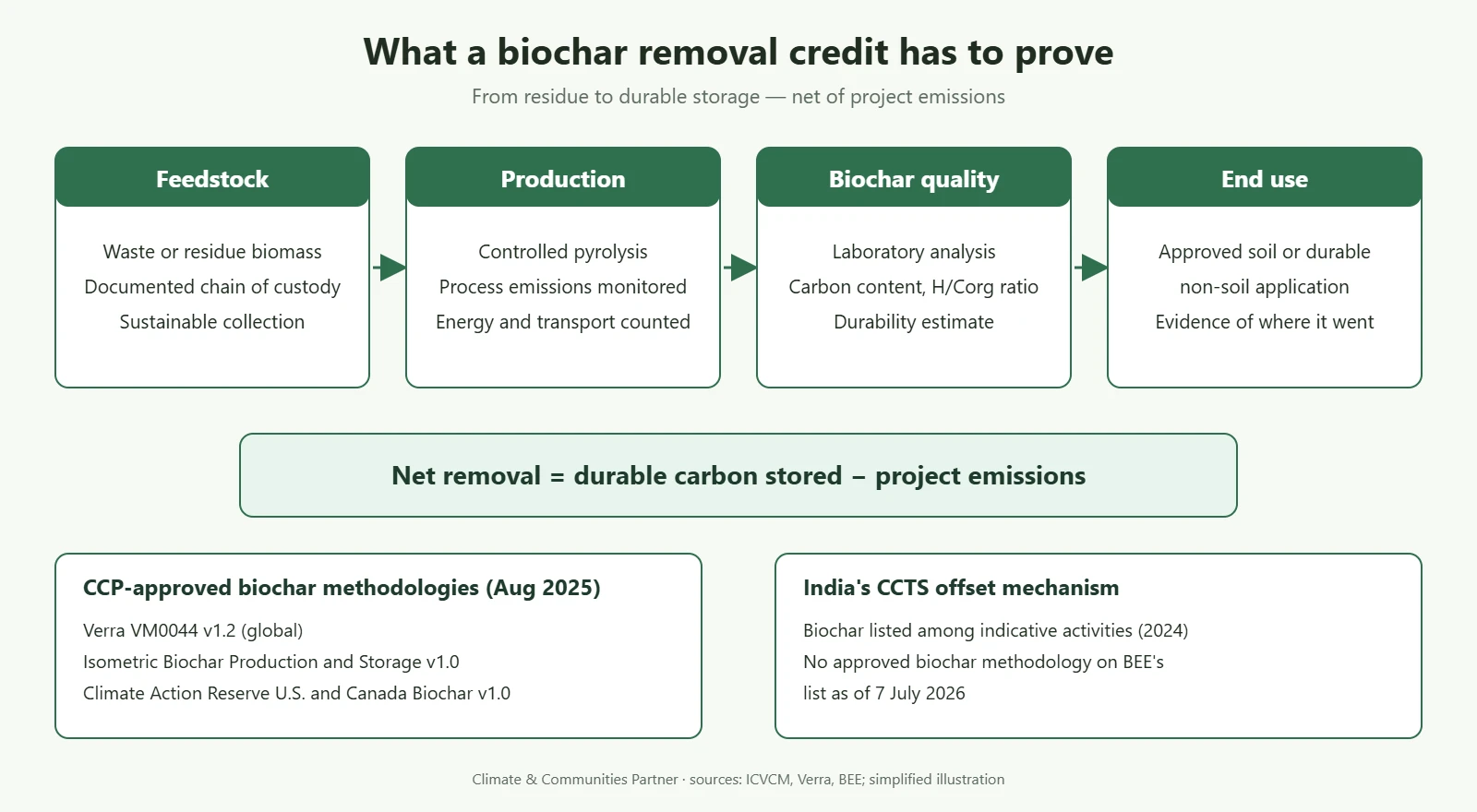
In August 2025 the Integrity Council for the Voluntary Carbon Market (ICVCM) approved three biochar methodologies for its Core Carbon Principles (CCP) label:

  • Verra VM0044 (Biochar Utilization in Soil and Non-Soil Applications, version 1.2), applicable globally;
  • Isometric Biochar Production and Storage (version 1.0);
  • Climate Action Reserve U.S. and Canada Biochar (version 1.0), which is geographically limited.

Other programmes, including Puro.earth, also certify biochar removals. For a project in India, the practical choice is usually between an international programme of this kind and waiting for a domestic route.

What a biochar removal credit has to prove
What a biochar removal credit has to prove, from feedstock to end use.

The domestic gap

When the Bureau of Energy Efficiency (BEE) approved sectors for the offset mechanism of India’s Carbon Credit Trading Scheme in 2024, biochar appeared among the indicative activities under both waste and agriculture. As of BEE’s list last updated on 7 July 2026, however, there is no approved biochar methodology under the offset mechanism. Until one is published, Indian biochar projects cannot earn domestic Carbon Credit Certificates.

What the methodologies actually test

  1. Feedstock. VM0044 credits biochar made from waste biomass at new production facilities. Developers need to show where the residue comes from, that it would not otherwise have been used in a way that stores carbon, and that collection does not degrade soils or forests.
  2. Production emissions. Pyrolysis releases methane and other gases if poorly controlled. Net removals are calculated after deducting process and transport emissions, so kiln technology matters directly to credit volumes.
  3. Durability. Methodologies use laboratory properties of the biochar, such as the ratio of hydrogen to organic carbon, to estimate how much carbon persists over the long term.
  4. End use. Under VM0044, producing biochar is not enough; it must reach an approved soil or durable non-soil application, with evidence of where it went.

Implications for Indian developers

Decentralised feedstock needs documented aggregation. Residues such as crop stubble, pine needles in the Himalayan states, or agro-processing waste are collected from many small sources. The chain of custody — who collected what, where and when — is part of the evidence package, not an afterthought.

Choose the programme before the kiln. Monitoring requirements for emissions and biochar quality differ by methodology, and retrofitting monitoring onto an operating plant is expensive.

Keep the domestic option open. If BEE publishes a biochar methodology, the domestic market becomes an alternative buyer base. Project documentation that already meets international standards will make that switch easier.

Climate & Communities Partner works on biomass and biochar carbon removal, from feedstock design to methodology selection and documentation.

Sources

Rice methane reduction: Verra VM0051, Gold Standard and BEE compared

Last reviewed: 12 November 2026

Flooded rice paddies produce methane as organic matter decomposes without oxygen. Alternate wetting and drying (AWD) — letting fields dry periodically between irrigations — and related water and crop management practices can cut those emissions while saving water. For an Indian rice programme there are now three credible routes to carbon credits, and they differ more than their titles suggest.

The three routes

Verra VM0051 Gold Standard AWD methodology BEE BM AG04.002
Programme Verified Carbon Standard Gold Standard for the Global Goals CCTS offset mechanism (India)
Unit Verified Carbon Units Gold Standard VERs Carbon Credit Certificates
Current version / status v1.1, active since 14 July 2026 v1.0 On BEE’s approved list (updated 7 July 2026)
ICVCM CCP label Approved (August 2026), with conditions Approved (conditional) Not applicable
Main buyers International voluntary buyers International voluntary buyers Indian obligated entities and domestic buyers
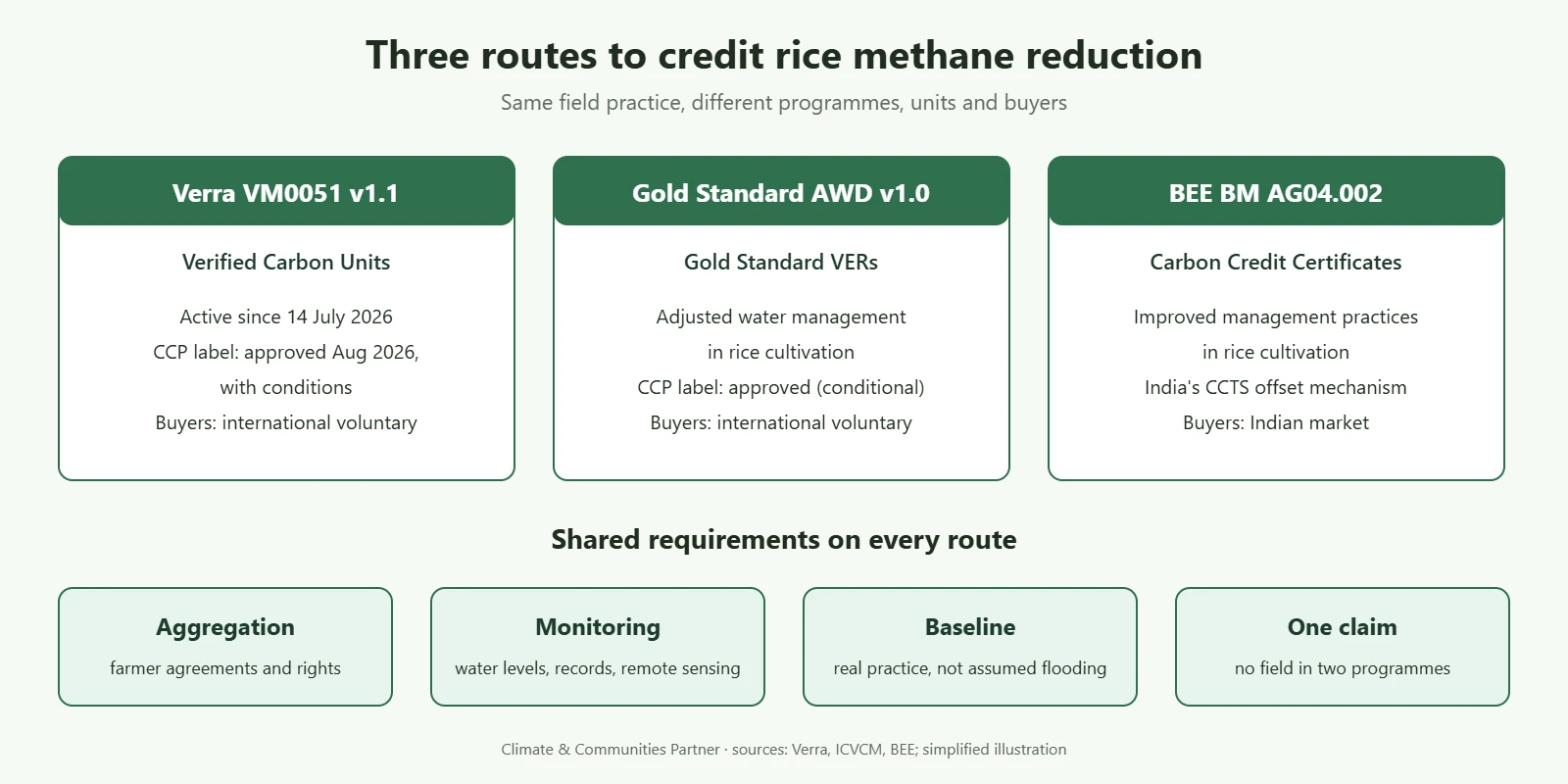
Three crediting routes for rice methane reduction
Three crediting routes for rice methane reduction, and the questions that decide between them.

What changed in 2026

Verra published VM0051 version 1.1 on 14 July 2026. It replaces the CDM methodology AMS-III.AU, which Verra inactivated in March 2023. Version 1.0 will be inactivated on 1 August 2027, after which new registrations and crediting-period renewals must use version 1.1. On 12 August 2026 the ICVCM approved VM0051 v1.1 for the CCP label. To receive labelled credits, projects must meet additional conditions, including a financial additionality benchmark and a five-year crediting period, renewable twice.

Domestically, the Ministry of Agriculture told Parliament in July 2026 that two agriculture methodologies are approved under the CCTS offset mechanism: methane recovery from livestock manure at households and small farms, and improved management practices in rice cultivation.

The hard parts are the same on every route

  • Aggregation. Indian rice is grown by smallholders. A credible programme needs farmer agreements, clear rights to the emission reductions and a benefit-sharing model that farmers understand.
  • Monitoring. Reductions depend on whether fields were actually drained. Field water-level data, farmer records and remote sensing need to agree.
  • Baseline and additionality. In areas with unreliable irrigation, fields may already dry out. The baseline must reflect real practice, not an assumed continuously flooded field.
  • One farm, one programme. The same field cannot generate credits under two programmes. Overlap checks against other registries and government schemes are essential before enrolment.

Choosing a route

The decision usually turns on three questions: who the buyer is (international voluntary buyers screening for the CCP label, or Indian buyers needing domestic certificates); how much monitoring the programme can realistically support; and whether the project wants to keep open an Article 6 route, which in India depends on the government’s list of eligible activities.

Climate & Communities Partner designs community-based agricultural carbon programmes, including methodology selection, aggregation and monitoring design.

Sources

Compressed biogas and carbon credits: domestic, voluntary or Article 6?

Last reviewed: 12 November 2026

Compressed biogas (CBG) sits in an unusual position in Indian climate policy. It has a domestic demand mandate, an approved methodology under India’s Carbon Credit Trading Scheme, and a place on the government’s list of activities eligible for international transfer under Article 6.2. For a CBG developer, that means a real choice about where the carbon value goes — and the choices are not interchangeable.

The policy backdrop

The National Biofuels Coordination Committee introduced a CBG Blending Obligation (CBO) for the CNG (transport) and PNG (domestic) segments of city gas distribution. It was voluntary until 2024–25 and became mandatory from 2025–26, at 1% of consumption, rising to 3% in 2026–27, 4% in 2027–28 and 5% from 2028–29. The Petroleum Minister told Parliament in August 2026 that CBG sales reached 1.05% in 2025–26, against the 1% target.

Three carbon routes

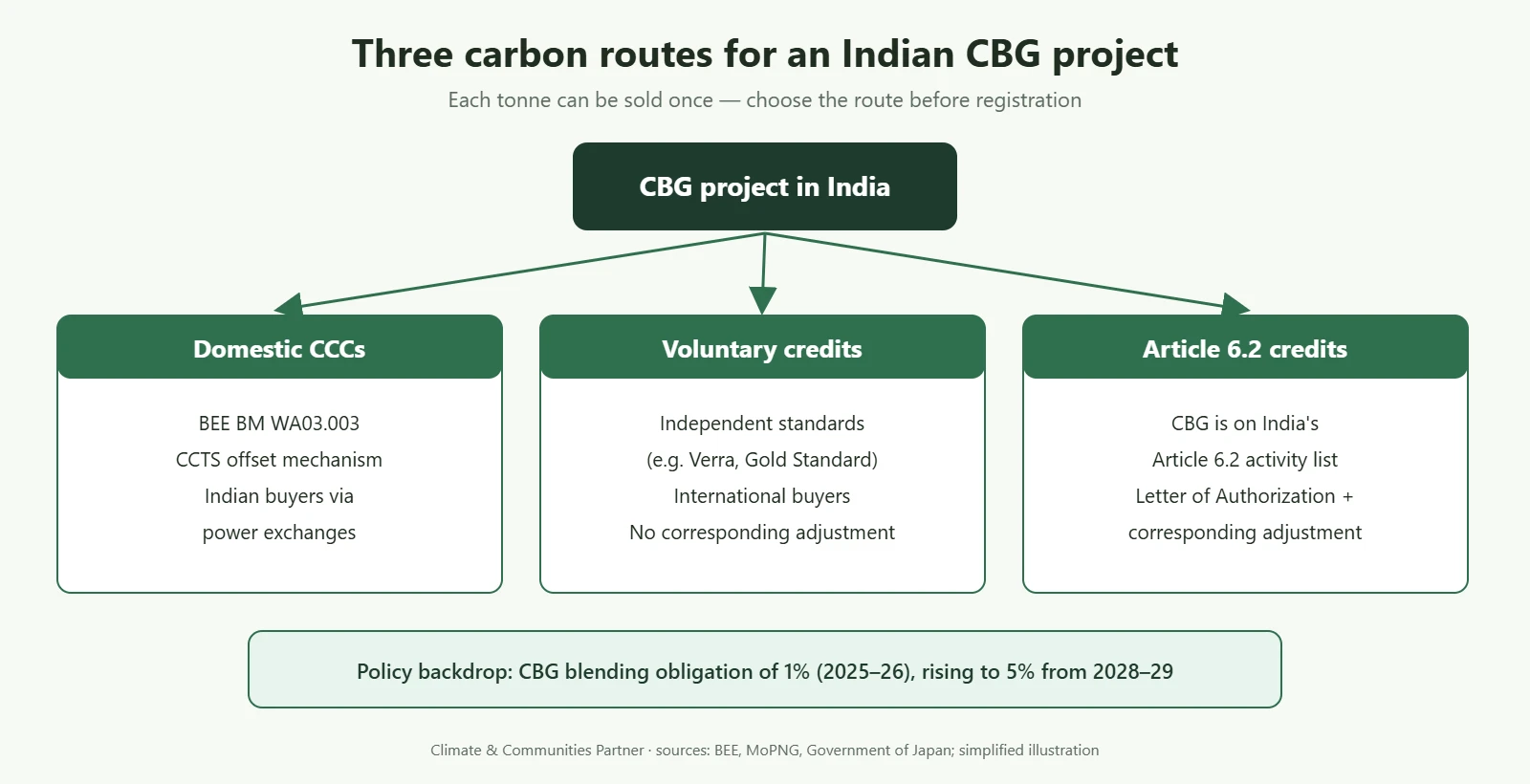
Three carbon routes for an Indian CBG project
The three carbon routes open to an Indian CBG project, and what each requires.

1. Domestic Carbon Credit Certificates. BEE’s methodology BM WA03.003, Production of Compressed Bio-gas, is on the approved list for the CCTS offset mechanism. Credits are sold to Indian buyers, including obligated entities, through the power exchanges once trading begins.

2. International voluntary credits. Independent standards such as Verra and Gold Standard have methodologies covering biogas and methane avoidance. Buyers are international corporates; the credits are not correspondingly adjusted unless authorised.

3. Article 6.2 authorised credits. CBG is on India’s list of activities eligible under Article 6.2, and India’s Joint Crediting Mechanism with Japan is now operational. Authorised credits carry a corresponding adjustment by India, which typically matters to compliance buyers and should be reflected in price.

Questions to settle early

  • Additionality in a mandated market. The blending obligation creates demand for CBG and other incentives may apply. Validators and buyers will ask how carbon revenue changes the project’s economics given that policy support.
  • Feedstock and digestate. Emission reductions depend on the baseline fate of the feedstock (for example, open burning or uncontrolled decay of agricultural residues, or manure management) and on how digestate is handled.
  • Leakage and fugitive methane. Plant losses directly reduce credited volumes. Monitoring of methane slip is a design choice, not a reporting detail.
  • No double claiming. One tonne can be credited only once. A project cannot sell the same reductions as a domestic certificate and an international credit.

Climate & Communities Partner advises on CBG carbon strategy, including methodology selection, route choice between domestic and international markets, and Article 6 eligibility.

Sources

Industrial energy efficiency under India’s CCTS offset mechanism

Last reviewed: 12 November 2026

Industrial energy efficiency rarely makes headlines in the carbon market, yet it is often among the lower-cost sources of real reductions. India’s Carbon Credit Trading Scheme now has a domestic methodology for it, which gives plant owners outside the compliance mechanism a way to monetise efficiency projects in rupees. The rules, however, are strict about what counts and who can claim it.

The methodology

BM IN02.001, Energy efficiency and fuel switching measures for industrial facilities, was published by the Bureau of Energy Efficiency (BEE) on 27 March 2025 as one of the first approved methodologies under the CCTS offset mechanism. Its scope covers energy efficiency measures at one or several industrial, mining or mineral production facilities. Typical projects include efficient motors, pumps and boilers, and process measures in operations such as furnaces and paper drying. Fuel switching is covered where it is an integral part of an efficiency package, for example moving from steam or compressed air to electricity. The scope wording closely follows the long-established CDM small-scale methodology AMS-II.D.

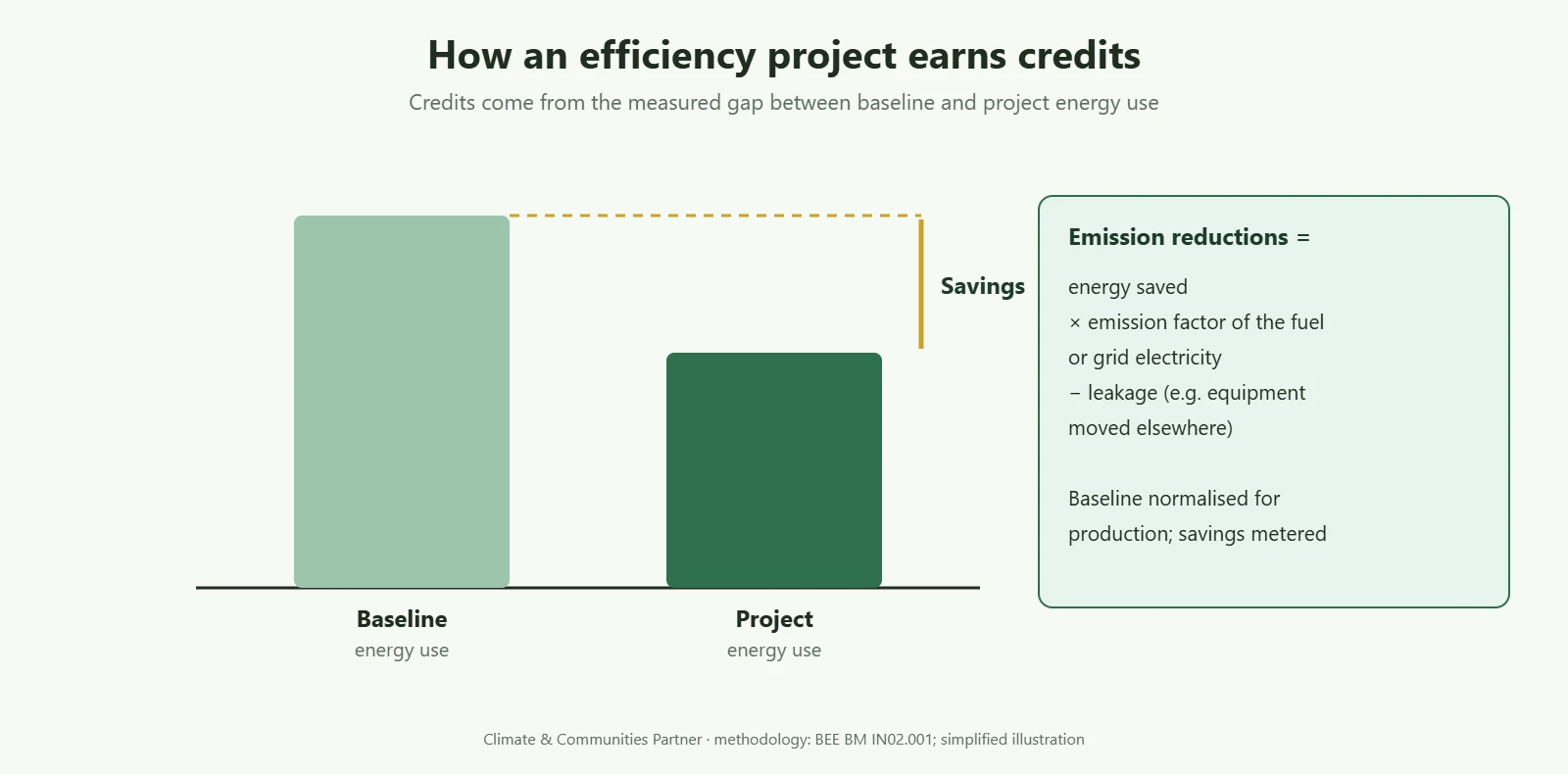
Baseline versus project energy use
How an efficiency project’s credits are calculated: the gap between the baseline and measured project energy use.

Who can use it

The offset mechanism is for non-obligated entities. A plant that already has a greenhouse gas emission intensity target under the compliance mechanism is rewarded for efficiency through its target: beating it earns Carbon Credit Certificates directly. Allowing the same plant to claim offset credits for the same savings would count the reduction twice. Where an obligated group wants to participate in the offset mechanism, BEE has indicated at stakeholder workshops that it must do so through a separate non-obligated entity; the formal procedure should be checked before any structure is set up.

What makes or breaks an efficiency project

  • Baseline energy use. Savings are measured against what the equipment or process would have consumed. That needs metered historical data, normalised for production levels.
  • Measurement. Sub-metering of the affected equipment is usually decisive. Estimates based on nameplate ratings rarely survive verification.
  • Interaction between measures. Where several measures are installed together, their savings overlap and must be accounted for jointly.
  • Equipment leaving the boundary. If replaced equipment is moved and used elsewhere, methodologies of this type require the resulting emissions to be considered as leakage.
  • Additionality. Many efficiency measures pay for themselves. Projects need to show why carbon revenue makes the difference, which is easiest for higher-cost measures.

Beyond the domestic route

High-end energy-efficiency technology is also on India’s list of activities eligible for international transfer under Article 6.2. For advanced technologies, an authorised international route — for example through the Joint Crediting Mechanism with Japan — may command more value than a domestic certificate, at the cost of a longer approval process.

Climate & Communities Partner advises industrial clients on efficiency and fuel-switch projects under the CCTS offset mechanism and Article 6.

Sources