Last reviewed: 12 November 2026
Biochar is a carbon removal pathway that can be built at village and district scale. It is made by heating biomass residues in a low-oxygen environment, producing a stable, carbon-rich solid that can be applied to soil or locked into durable materials. For India, with large volumes of crop and forest residues, it is an obvious candidate. The question for a developer is not whether biochar removes carbon, but which rulebook will credit it, and on what evidence.
Where biochar can be credited today
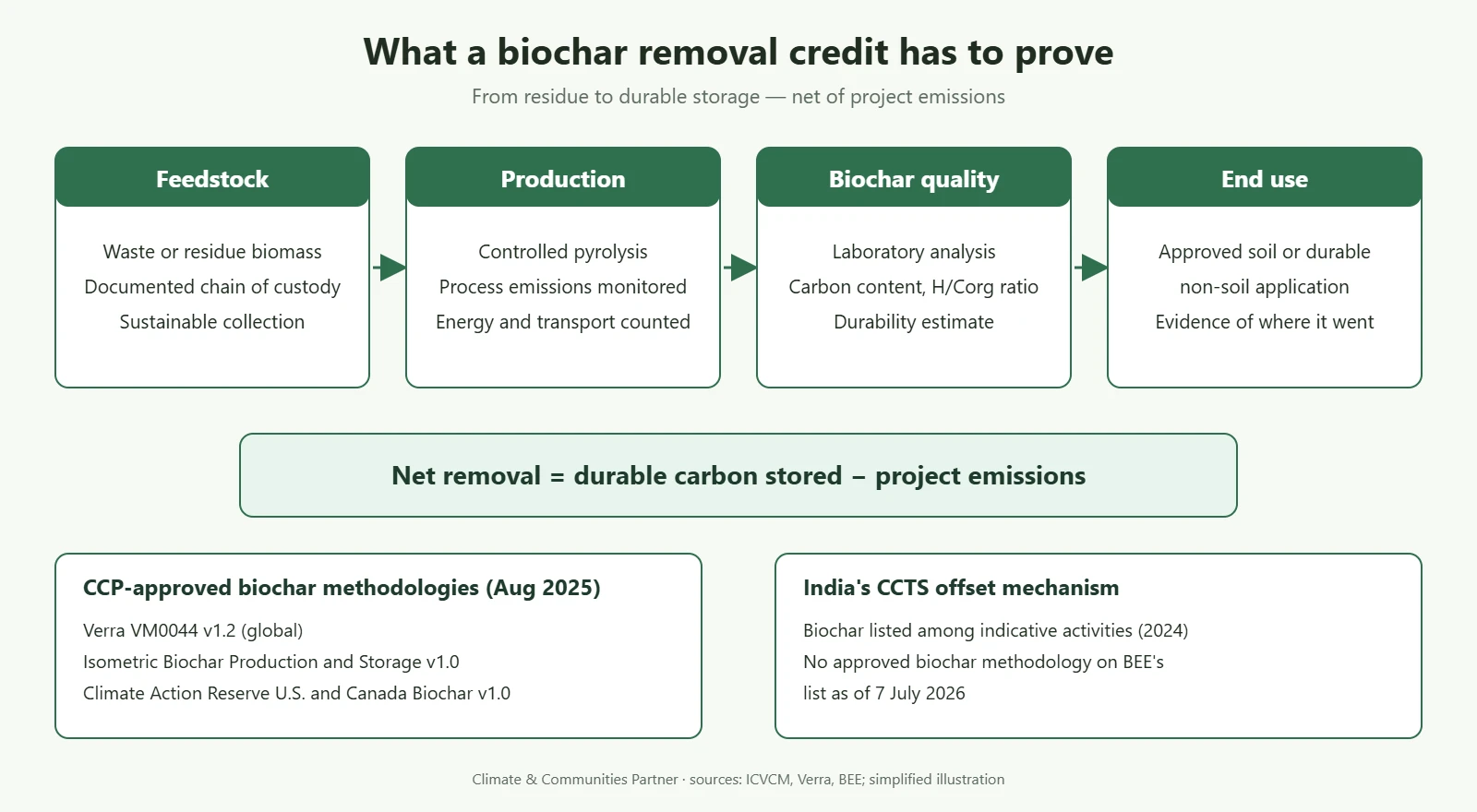
In August 2025 the Integrity Council for the Voluntary Carbon Market (ICVCM) approved three biochar methodologies for its Core Carbon Principles (CCP) label:
- Verra VM0044 (Biochar Utilization in Soil and Non-Soil Applications, version 1.2), applicable globally;
- Isometric Biochar Production and Storage (version 1.0);
- Climate Action Reserve U.S. and Canada Biochar (version 1.0), which is geographically limited.
Other programmes, including Puro.earth, also certify biochar removals. For a project in India, the practical choice is usually between an international programme of this kind and waiting for a domestic route.
The domestic gap
When the Bureau of Energy Efficiency (BEE) approved sectors for the offset mechanism of India’s Carbon Credit Trading Scheme in 2024, biochar appeared among the indicative activities under both waste and agriculture. As of BEE’s list last updated on 7 July 2026, however, there is no approved biochar methodology under the offset mechanism. Until one is published, Indian biochar projects cannot earn domestic Carbon Credit Certificates.
What the methodologies actually test
- Feedstock. VM0044 credits biochar made from waste biomass at new production facilities. Developers need to show where the residue comes from, that it would not otherwise have been used in a way that stores carbon, and that collection does not degrade soils or forests.
- Production emissions. Pyrolysis releases methane and other gases if poorly controlled. Net removals are calculated after deducting process and transport emissions, so kiln technology matters directly to credit volumes.
- Durability. Methodologies use laboratory properties of the biochar, such as the ratio of hydrogen to organic carbon, to estimate how much carbon persists over the long term.
- End use. Under VM0044, producing biochar is not enough; it must reach an approved soil or durable non-soil application, with evidence of where it went.
Implications for Indian developers
Decentralised feedstock needs documented aggregation. Residues such as crop stubble, pine needles in the Himalayan states, or agro-processing waste are collected from many small sources. The chain of custody — who collected what, where and when — is part of the evidence package, not an afterthought.
Choose the programme before the kiln. Monitoring requirements for emissions and biochar quality differ by methodology, and retrofitting monitoring onto an operating plant is expensive.
Keep the domestic option open. If BEE publishes a biochar methodology, the domestic market becomes an alternative buyer base. Project documentation that already meets international standards will make that switch easier.
Climate & Communities Partner works on biomass and biochar carbon removal, from feedstock design to methodology selection and documentation.
Sources
- ICVCM – Integrity Council approves biochar and IFM methodologies (13 August 2025)
- Verra – VM0044 Biochar Utilization in Soil and Non-Soil Applications, v1.2
- Bureau of Energy Efficiency – Methodologies and tools under the offset mechanism
- OPIS – India approves ten sectors for carbon offset market