Rice methane reduction: Verra VM0051, Gold Standard and BEE compared
Last reviewed: 12 November 2026
Flooded rice paddies produce methane as organic matter decomposes without oxygen. Alternate wetting and drying (AWD) — letting fields dry periodically between irrigations — and related water and crop management practices can cut those emissions while saving water. For an Indian rice programme there are now three credible routes to carbon credits, and they differ more than their titles suggest.
The three routes
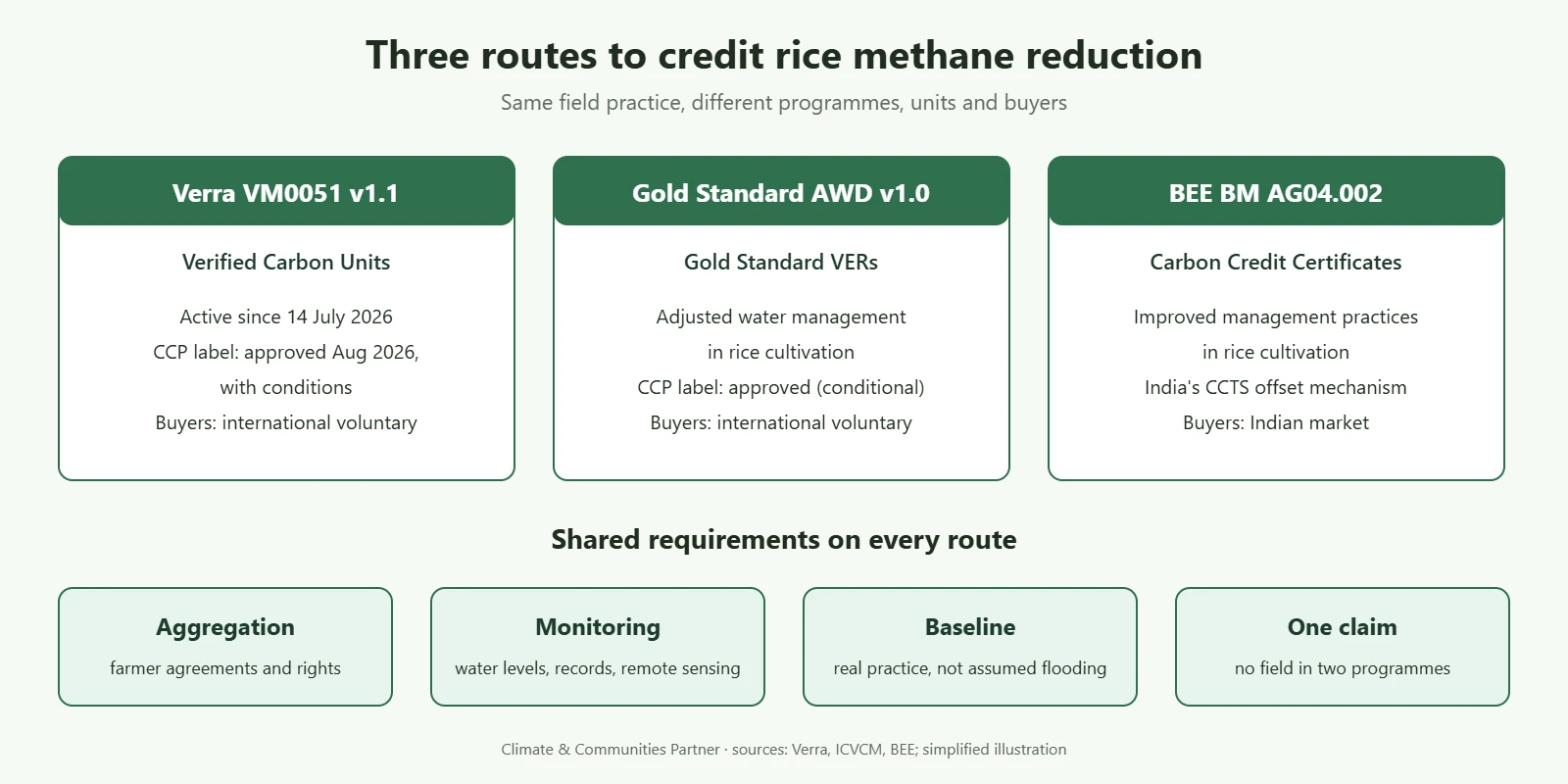
| Verra VM0051 | Gold Standard AWD methodology | BEE BM AG04.002 | |
|---|---|---|---|
| Programme | Verified Carbon Standard | Gold Standard for the Global Goals | CCTS offset mechanism (India) |
| Unit | Verified Carbon Units | Gold Standard VERs | Carbon Credit Certificates |
| Current version / status | v1.1, active since 14 July 2026 | v1.0 | On BEE’s approved list (updated 7 July 2026) |
| ICVCM CCP label | Approved (August 2026), with conditions | Approved (conditional) | Not applicable |
| Main buyers | International voluntary buyers | International voluntary buyers | Indian obligated entities and domestic buyers |
What changed in 2026
Verra published VM0051 version 1.1 on 14 July 2026. It replaces the CDM methodology AMS-III.AU, which Verra inactivated in March 2023. Version 1.0 will be inactivated on 1 August 2027, after which new registrations and crediting-period renewals must use version 1.1. On 12 August 2026 the ICVCM approved VM0051 v1.1 for the CCP label. To receive labelled credits, projects must meet additional conditions, including a financial additionality benchmark and a five-year crediting period, renewable twice.
Domestically, the Ministry of Agriculture told Parliament in July 2026 that two agriculture methodologies are approved under the CCTS offset mechanism: methane recovery from livestock manure at households and small farms, and improved management practices in rice cultivation.
The hard parts are the same on every route
- Aggregation. Indian rice is grown by smallholders. A credible programme needs farmer agreements, clear rights to the emission reductions and a benefit-sharing model that farmers understand.
- Monitoring. Reductions depend on whether fields were actually drained. Field water-level data, farmer records and remote sensing need to agree.
- Baseline and additionality. In areas with unreliable irrigation, fields may already dry out. The baseline must reflect real practice, not an assumed continuously flooded field.
- One farm, one programme. The same field cannot generate credits under two programmes. Overlap checks against other registries and government schemes are essential before enrolment.
Choosing a route
The decision usually turns on three questions: who the buyer is (international voluntary buyers screening for the CCP label, or Indian buyers needing domestic certificates); how much monitoring the programme can realistically support; and whether the project wants to keep open an Article 6 route, which in India depends on the government’s list of eligible activities.
Climate & Communities Partner designs community-based agricultural carbon programmes, including methodology selection, aggregation and monitoring design.
Sources
- Verra – VM0051 Improved Management in Rice Production Systems and ICVCM approval announcement (12 August 2026)
- ICVCM – Decisions on reforestation, IFM and rice cultivation methodologies
- Bureau of Energy Efficiency – Methodologies under the offset mechanism
- Parliament reply of 21 July 2026, as reported by Katyayani Organics