Compressed biogas and carbon credits: domestic, voluntary or Article 6?
Last reviewed: 12 November 2026
Compressed biogas (CBG) sits in an unusual position in Indian climate policy. It has a domestic demand mandate, an approved methodology under India’s Carbon Credit Trading Scheme, and a place on the government’s list of activities eligible for international transfer under Article 6.2. For a CBG developer, that means a real choice about where the carbon value goes — and the choices are not interchangeable.
The policy backdrop
The National Biofuels Coordination Committee introduced a CBG Blending Obligation (CBO) for the CNG (transport) and PNG (domestic) segments of city gas distribution. It was voluntary until 2024–25 and became mandatory from 2025–26, at 1% of consumption, rising to 3% in 2026–27, 4% in 2027–28 and 5% from 2028–29. The Petroleum Minister told Parliament in August 2026 that CBG sales reached 1.05% in 2025–26, against the 1% target.
Three carbon routes
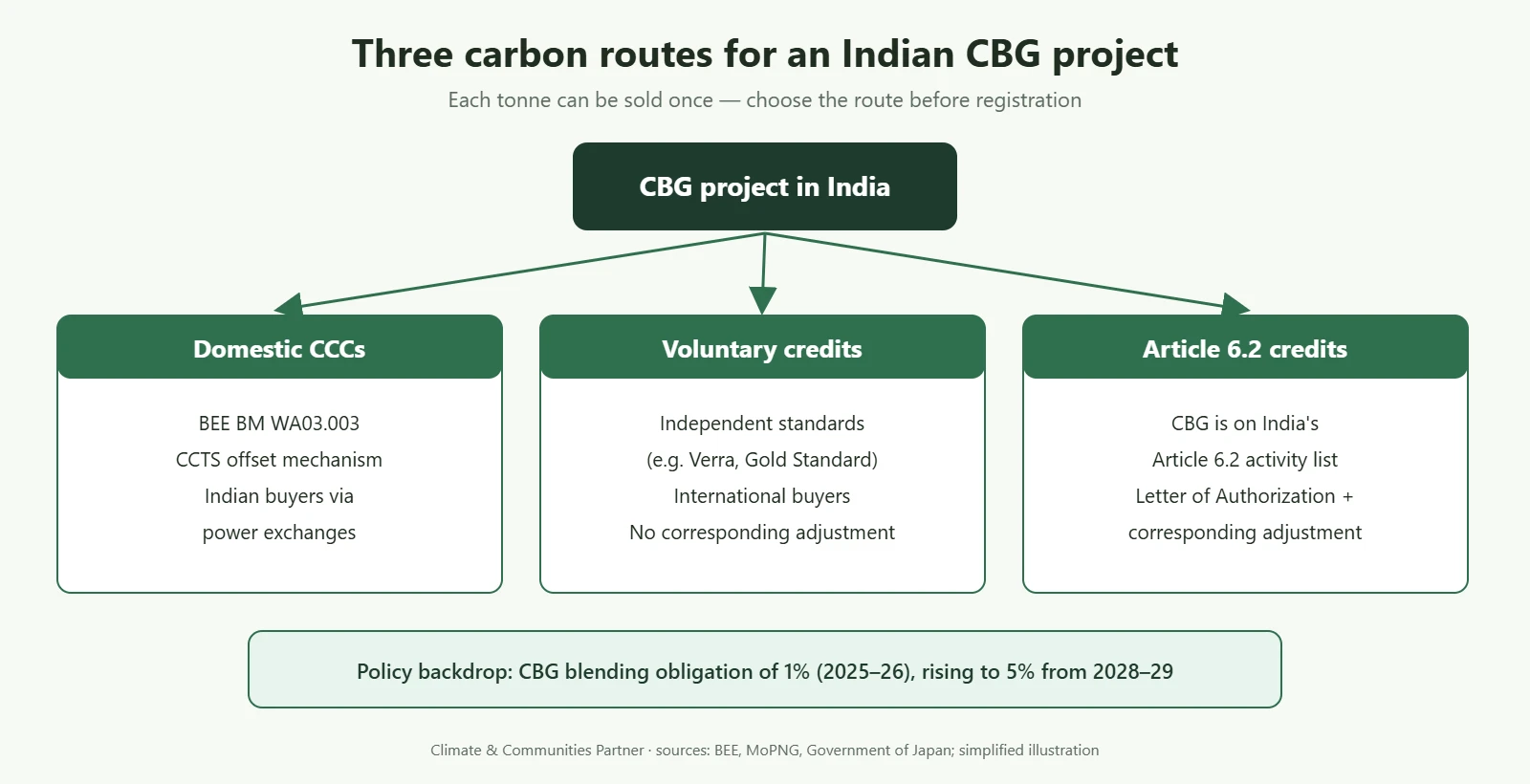
1. Domestic Carbon Credit Certificates. BEE’s methodology BM WA03.003, Production of Compressed Bio-gas, is on the approved list for the CCTS offset mechanism. Credits are sold to Indian buyers, including obligated entities, through the power exchanges once trading begins.
2. International voluntary credits. Independent standards such as Verra and Gold Standard have methodologies covering biogas and methane avoidance. Buyers are international corporates; the credits are not correspondingly adjusted unless authorised.
3. Article 6.2 authorised credits. CBG is on India’s list of activities eligible under Article 6.2, and India’s Joint Crediting Mechanism with Japan is now operational. Authorised credits carry a corresponding adjustment by India, which typically matters to compliance buyers and should be reflected in price.
Questions to settle early
- Additionality in a mandated market. The blending obligation creates demand for CBG and other incentives may apply. Validators and buyers will ask how carbon revenue changes the project’s economics given that policy support.
- Feedstock and digestate. Emission reductions depend on the baseline fate of the feedstock (for example, open burning or uncontrolled decay of agricultural residues, or manure management) and on how digestate is handled.
- Leakage and fugitive methane. Plant losses directly reduce credited volumes. Monitoring of methane slip is a design choice, not a reporting detail.
- No double claiming. One tonne can be credited only once. A project cannot sell the same reductions as a domestic certificate and an international credit.
Climate & Communities Partner advises on CBG carbon strategy, including methodology selection, route choice between domestic and international markets, and Article 6 eligibility.
Sources
- Ministry of Petroleum and Natural Gas announcement, as reported by Natural Gas World and IamRenew
- Parliament reply on 2025–26 blending, as reported by Swarajya
- Bureau of Energy Efficiency – Methodologies under the offset mechanism
- Ministry of Environment, Government of Japan – Eligible activities in India under Article 6.2