Choosing a carbon standard in 2026: Verra, Gold Standard and what buyers now check
Last reviewed: 12 November 2026
A carbon credit is only as useful as the rulebook behind it. That rulebook is the standard, or crediting programme: it decides which methodologies a project may use, who checks the numbers, how credits are issued and retired, and increasingly whether a credit can travel into compliance markets such as CORSIA or Article 6 of the Paris Agreement. Choosing the standard is one of the first decisions in a project and one of the hardest to reverse.
What a standard actually does
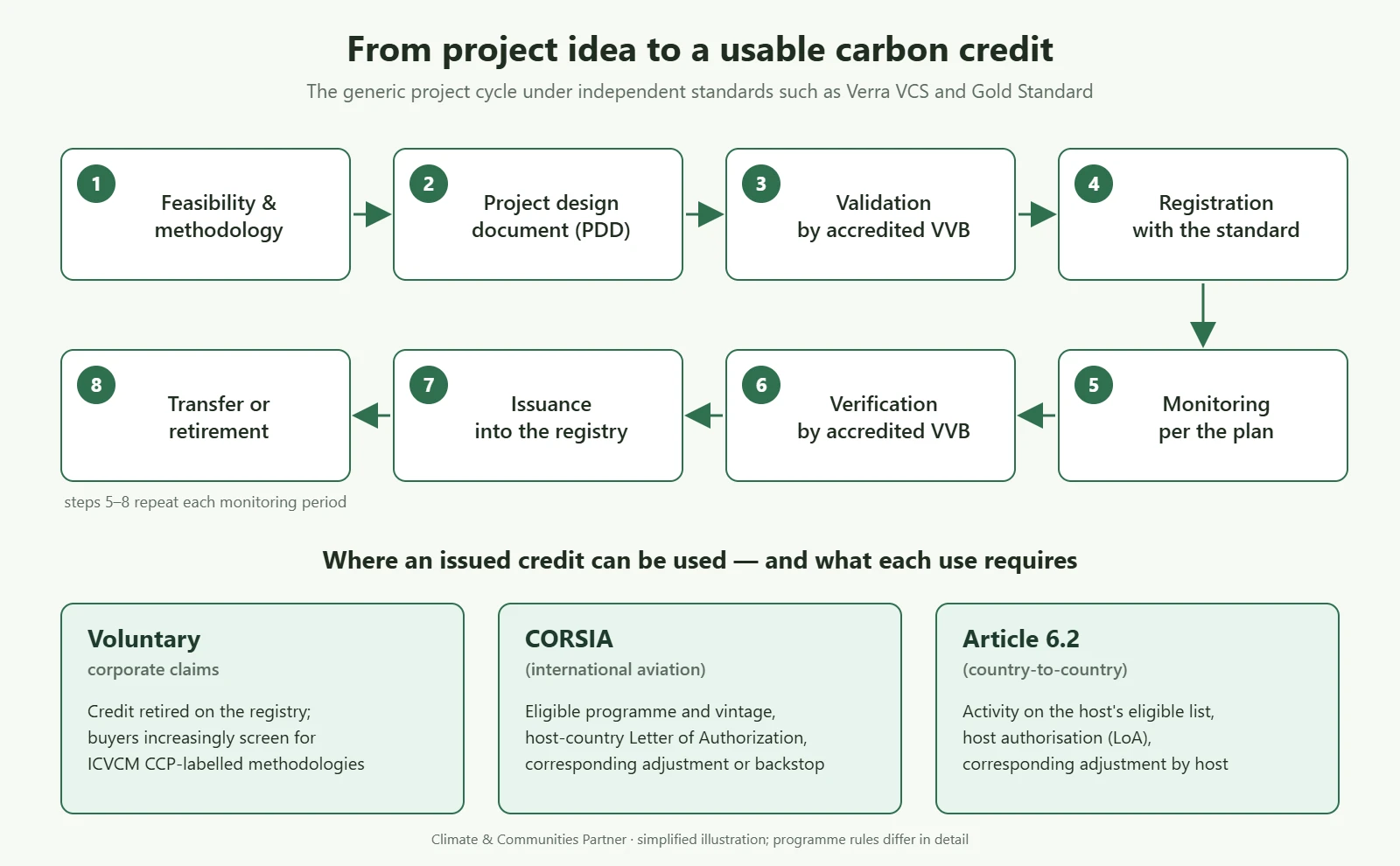
Independent standards share a common architecture. The standard publishes programme rules and approves methodologies. A project applies one methodology, describes itself in a project design document, and is checked by an accredited third party, a validation and verification body (VVB), before registration. After each monitoring period the VVB verifies the reported reductions or removals, and the standard issues credits into its registry, where they can be transferred or retired.
The main programmes in 2026
- Verra – Verified Carbon Standard (VCS). Covers energy, industry, waste, agriculture and land use. Verra released VCS Version 5 on 16 December 2025. In October 2026 it moved the effective date for most Version 5 requirements, including the mandatory new project templates, from 1 January 2027 to 1 July 2027. Projects may adopt Version 5 earlier.
- Gold Standard for the Global Goals (GS4GG). Widely used for community-scale activities such as clean cooking and household biogas, and certifies sustainable-development outcomes alongside emission reductions. Gold Standard operates a labelling process for credits authorised under Article 6; only reductions and removals achieved from 2021 onwards can be authorised.
- Other programmes. Global Carbon Council, Isometric and Puro.earth (focused on carbon removal), American Carbon Registry, Climate Action Reserve and ART TREES (jurisdictional forest crediting) each serve specific project types or buyer groups.
The quality layer: ICVCM and the CCP label
The Integrity Council for the Voluntary Carbon Market (ICVCM) does not issue credits. It assesses programmes and methodologies against its Core Carbon Principles. A credit can carry the CCP label only if it comes from a CCP-Approved methodology under a CCP-Eligible programme. The assessments are methodology by methodology, and they have consequences: in 2024 the ICVCM declined to approve the older renewable-energy methodologies, citing additionality; in May 2026 it approved a revised Verra renewable-energy methodology (VMR0017) with conditions. For a developer, the practical question is no longer only “which standard?” but “which methodology version, and does it carry the label buyers screen for?”
Where the credit will be used decides more than it used to
Voluntary corporate use. The credit is retired on the registry against a claim. Buyer due diligence increasingly starts with the CCP label, the methodology version and the project’s monitoring evidence.
CORSIA (international aviation). For the First Phase (2024–2026), eligible units must come from an ICAO-approved programme and an eligible vintage, and carry a host-country Letter of Authorization with either evidence of a corresponding adjustment or a programme backstop. Airlines must retire units for the First Phase by 31 January 2028. According to IATA, ten countries had released eligible units through Letters of Authorization as of April 2026, which is why supply remains tight.
Article 6.2 transfers. The host government authorises the mitigation outcome and applies a corresponding adjustment. The independent standard still issues and tracks the credit, but its value now depends on a sovereign decision as much as on the methodology.
A practical checklist before choosing
- Methodology fit. Is there an active methodology for the activity under this programme, and which version applies after the programme’s next effective date?
- Label status. Is that methodology CCP-Approved, conditionally approved, or not yet assessed?
- End market. Voluntary, CORSIA, Article 6.2 or a domestic scheme? Each adds conditions, and some (authorisation, corresponding adjustment) sit outside the developer’s control.
- Host-country position. For India, check whether the activity is on the government’s Article 6.2 list and whether a domestic route under the Carbon Credit Trading Scheme is more suitable.
- Cost and time. Registration and issuance fees, VVB availability and review timelines differ by programme and should be in the financial model from day one.
Climate & Communities Partner advises project developers on standard and methodology selection, project documentation and the authorisation questions that now sit alongside them.
Sources
- Verra – New effective date for VCS Version 5 and About VCS Program Version 5
- Gold Standard – Article 6 and CORSIA labelling: step-by-step guide
- ICVCM – May 2026 assessment decisions
- IATA – CORSIA; Norton Rose Fulbright – CORSIA: a market update