Forest fires in the Western Himalaya: what is being lost and what would help
Last reviewed: 16 November 2026
Uttarakhand’s official forest fire season runs from 15 February to 15 June. Every year, forest department teams prepare for it by cleaning fire lines, cutting grass and bushes, and carrying out controlled burning. That groundwork matters more each year.
What the recent record shows
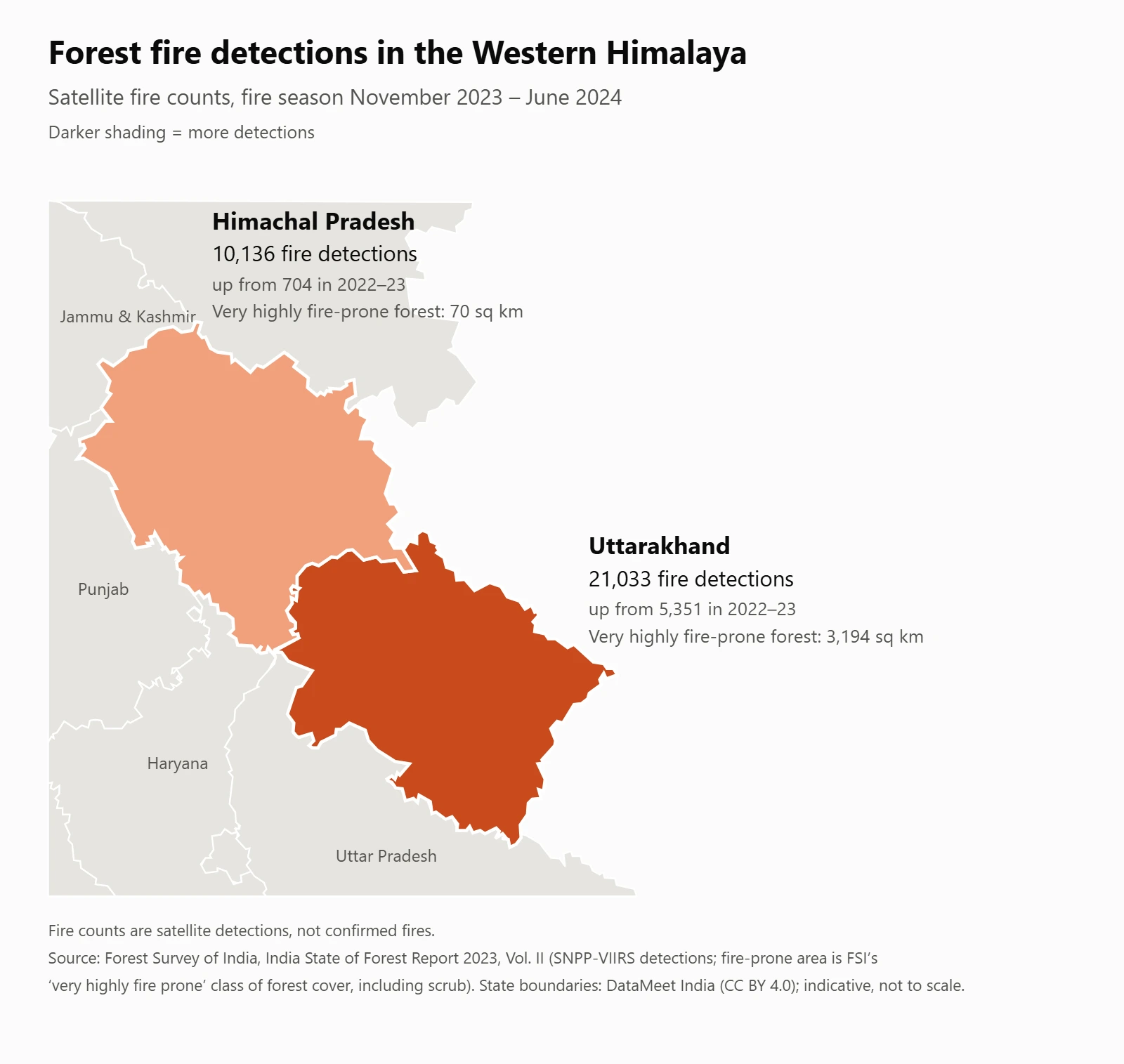
Forest Survey of India (FSI) satellites recorded 21,033 fire counts in Uttarakhand from November 2023 to June 2024, up from 5,351 a year earlier. In Himachal Pradesh, the count rose from 704 to 10,136 over the same two seasons. In 2024, forest fires killed 12 people in Uttarakhand.
What gets lost
- Wildlife. Cheer pheasant, kalij pheasant and Himalayan monal breed from April to June, in the middle of the fire season. The cheer pheasant nests on the ground in dense bushes. Reptiles and mammals cannot escape flames as quickly as birds, and butterfly larvae burn along with their host plants.
- Forest. Frequent fires favour chir pine over broadleaf oak. Chir pine already accounts for nearly 57% of fire incidents in the Western Himalaya. In fire-prone Uttarakhand forests, researchers found fire-tolerant species becoming more dominant where fires are frequent, and warned that tree diversity could decline.
- Soil. Research in Uttarakhand found that fires cut soil organic carbon by an average of 35%, nitrogen by 25% and phosphorus by 15%.
- Glaciers. An ICIMOD scientist estimated in 2020 that 30–40% of the black carbon deposited in the Himalaya in April and May comes from forest fires.
Field teams need better data
In August 2026, a parliamentary committee reported that only about 12.5% of FSI fire alerts in Uttarakhand corresponded to actual fires. It recommended structured training to help nodal officers interpret and prioritise alerts. Sharper alerts and shared, ground-verified data would let field teams focus on real fires and strengthen the case for prevention funding.
What would help
- Back the pre-season work on fire lines and fuel clearance before 15 February.
- Pay the communities who work alongside the forest department on prevention.
- Give prevention reliable funding. The central Forest Fire Prevention and Management scheme ended in 2025-26 and is under review.
- Build one ground-verified burnt-area dataset that departments, funders and researchers can all use.
- Give forest biomass a value. When material cleared from the forest floor can become biochar, boards or fuels, removing it before the fire season has an income attached.
Climate & Communities Partner is working on value addition from forest biomass, including biochar, boards and fuels.
If you work on this problem, we would like to hear from you. That includes forest departments, Van Panchayats, funders, and companies with Himalayan supply chains or nature-based carbon exposure. Contact Climate & Communities Partner.
Sources
- Forest Survey of India – India State of Forest Report 2023, Vol. II (fire counts and fire-prone area)
- PRS Legislative Research – Report summary: Forest fires in the Himalayan region (Standing Committee report, 7 August 2026)
- Hindustan Times Uttarakhand – State maps at-risk zones (official fire season)
- Hindustan Times Uttarakhand – What made headlines in 2024 (2024 deaths)
- Newslaundry – Uttarakhand forest fires and pre-season preparation
- Down To Earth – Forest fires and Uttarakhand’s biodiversity
- ThePrint – Forest fires threaten rare Himalayan fauna
- Daily Excelsior – Forest fires in Uttarakhand threaten rare Himalayan fauna
- Down To Earth – Fire in the mountains
- Current Science – Nature of forest fires in Uttarakhand
- Frontiers in Forests and Global Change – Effect of forest fire on tree diversity and regeneration in Uttarakhand (2023)
- Mongabay India – How frequent forest fires can lead to ecosystem changes
- Mongabay India – Rising temperatures drive Himalayan forest fires
- Dialogue Earth – Fire and ice: soot darkens Himalayan glaciers
- Map boundaries – DataMeet India (CC BY 4.0)