India’s Carbon Credit Trading Scheme: where it stands in November 2026
Last reviewed: 12 November 2026
India’s Carbon Credit Trading Scheme (CCTS) has moved from notification to obligation. Industrial plants in seven sectors have legally binding emission-intensity targets, the offset rulebook is in place, and the trading rules have been written. What has not yet happened is the first trade. This note sets out where the scheme stands, and what it means for obligated companies and for project developers.
The architecture
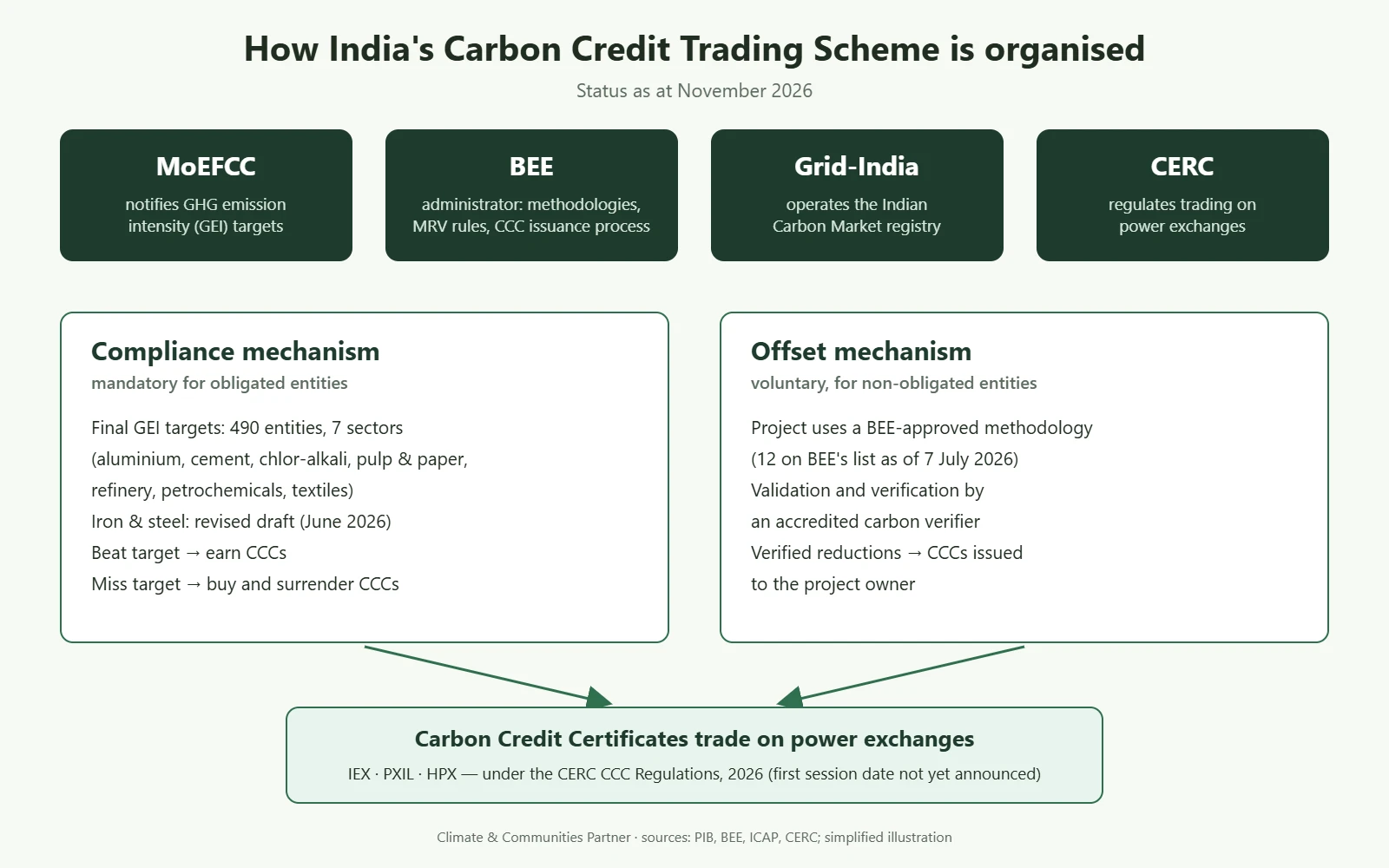
The scheme was notified in June 2023 under the Energy Conservation (Amendment) Act, 2022, and amended in December 2023 to add an offset mechanism. It operates through two mechanisms. Under the compliance mechanism, emission-intensive industries are designated as obligated entities and given greenhouse gas emission intensity (GEI) targets: tonnes of CO2e per unit of output, not an absolute cap. Entities that outperform their targets receive Carbon Credit Certificates (CCCs); entities that fall short must buy and surrender them. Under the offset mechanism, non-obligated entities can register projects that reduce, avoid or remove emissions and receive CCCs for verified results.
Who is covered today
Final GEI targets were notified in two rounds. In October 2025 the government notified targets for aluminium, cement, chlor-alkali and pulp & paper, covering 282 obligated entities. In January 2026 it added refinery, petrochemicals, textiles and secondary aluminium, bringing the total to 490 obligated entities. Targets were set for compliance years 2025–26 and 2026–27, with 2023–24 as the baseline year. The list is already moving: an amendment dated 7 September 2026, reported by Business Standard in November, withdrew the 2025–26 targets for the refinery and textile sectors, while their 2026–27 targets remain in place.
Iron and steel, the largest prospective addition, is not yet final. A revised draft notification dated 26 June 2026 proposes targets for 255 units for 2026–27 only, leaving the 2025–26 column blank. Fertilisers, also named as a CCTS sector, do not yet have final targets.
Trading: rules written, first session pending
The Central Electricity Regulatory Commission (CERC) notified its regulations for the purchase and sale of CCCs on 27 February 2026. CCCs will trade only on CERC-registered power exchanges — IEX, PXIL and HPX — within a floor and a forbearance (ceiling) price approved by CERC. In October 2026 the Bureau of Energy Efficiency (BEE) issued a detailed procedure for CCC transactions: sessions on the last Thursday of each month, with prices discovered through a uniform-price auction. As at the date of this note, we have not seen a published floor or ceiling price or a confirmed date for the first session; trading also depends on the first issuance of certificates following verification of 2025–26 performance. An entity that does not surrender enough certificates faces environmental compensation of twice the average CCC price traded during the compliance year.
The offset mechanism: twelve methodologies, and notable gaps
BEE’s list of approved offset methodologies, last updated on 7 July 2026, contains twelve methodologies:
| Sector | Approved methodologies |
|---|---|
| Energy | Grid-connected renewable electricity; hydrogen from electrolysis of water; electricity and heat from biomass |
| Industries | Energy efficiency and fuel switching at industrial facilities; hydrogen from biogas methane |
| Waste | Landfill methane recovery; flaring or use of landfill gas; compressed biogas (CBG) production |
| Agriculture | Methane recovery from livestock and manure at households and small farms; improved management practices in rice cultivation |
| Forestry | Afforestation and reforestation of degraded mangrove habitats; afforestation and reforestation of lands except wetlands |
The gaps matter as much as the list. When BEE approved sectors for the offset mechanism in 2024, its indicative activities included biochar and agroforestry. Neither has an approved CCTS methodology yet. A biochar or agroforestry developer in India therefore still has to look to international standards, or wait.
What this means in practice
For obligated entities, the binding constraint is verified data. Each plant’s position against its target determines whether it holds surplus certificates or a shortfall, and banking of CCCs is permitted, so surplus holders have no obligation to sell in the first session. Compliance planning should rest on verified intensity figures, not on expected market prices, until the first price is actually discovered.
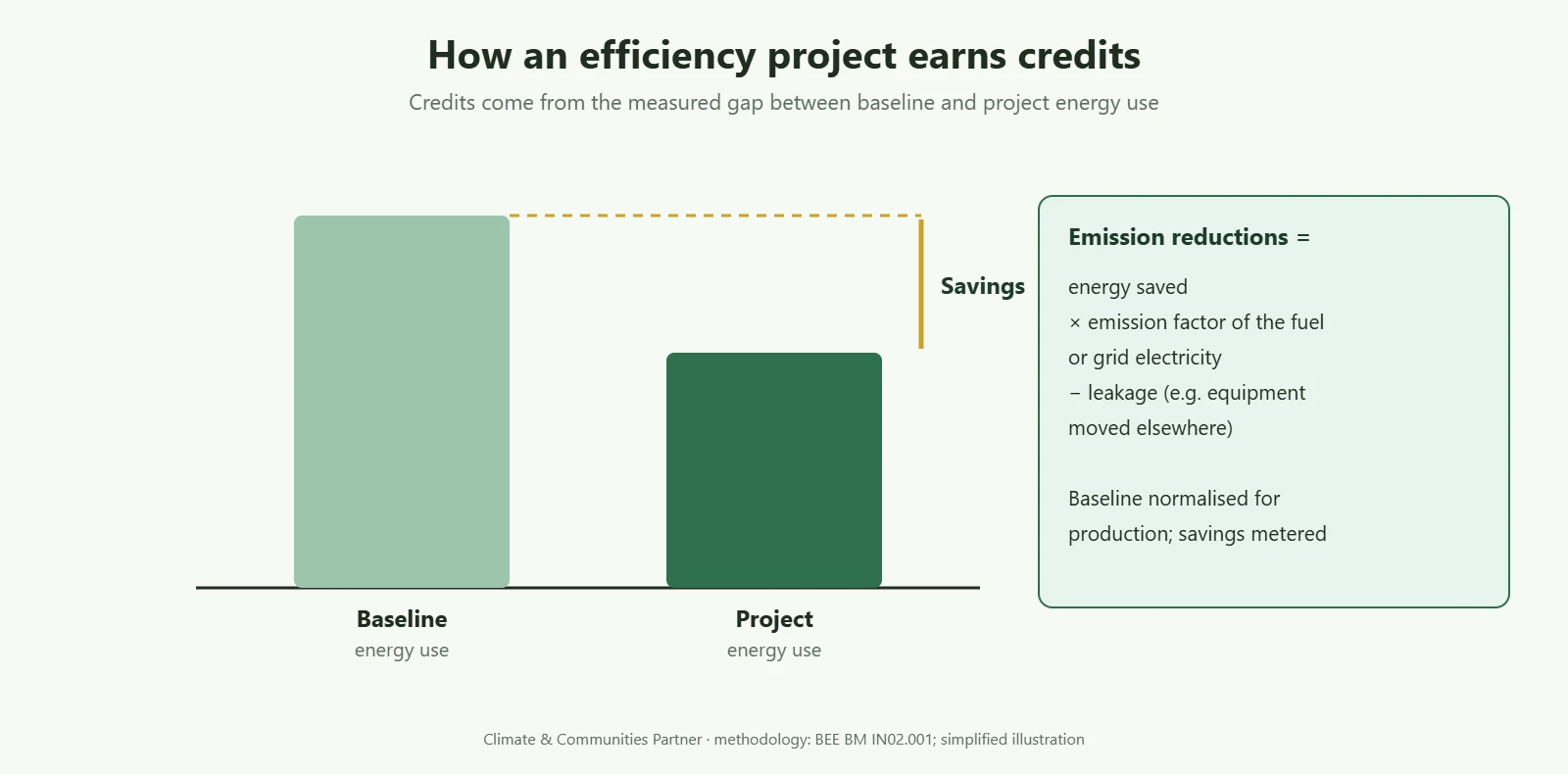
For project developers, the CCTS offset route is now a real alternative to the voluntary market for activities that have an approved BEE methodology, such as CBG, improved rice management or industrial energy efficiency. The choice between a domestic CCC, an international voluntary credit and an Article 6.2-authorised credit depends on the methodology available, who the buyer is, and whether the activity can be authorised for export.
Climate & Communities Partner advises obligated entities and project developers on the CCTS compliance and offset mechanisms, and on choosing between domestic and international routes.
Sources
- PIB, Ministry of Environment, Forest and Climate Change – GEI targets for 208 more industries (22 January 2026)
- PIB, Ministry of Power – Carbon Credit Trading Scheme (5 February 2026)
- Bureau of Energy Efficiency – Methodologies and tools under the offset mechanism
- ICAP – Indian Carbon Credit Trading Scheme
- IETA – Business brief: India’s CCTS
- Energetica India – BEE sets monthly trading schedule for Carbon Credit Certificates (2 November 2026)
- Business Standard – India drops FY26 emission targets for refiners, textiles (4 November 2026)
- Draft iron and steel targets (G.S.R. 517(E), 26 June 2026), as reported by TaxTMI