EU CBAM and India’s carbon market: what exporters of steel, aluminium and cement need to know
Last reviewed: 12 November 2026
Since 1 January 2026, the European Union has been putting a price on the carbon embedded in imported steel, aluminium, cement, fertilisers, hydrogen and electricity. India’s own carbon market, meanwhile, has targets but no traded price yet. For Indian exporters in these sectors, the gap between the two systems is now a cost line.
How CBAM works in its definitive phase
The Carbon Border Adjustment Mechanism moved from reporting-only to its definitive phase on 1 January 2026. EU importers of covered goods, acting as authorised CBAM declarants, must declare the embedded emissions of what they import and surrender CBAM certificates to cover them. For 2026 imports, the European Commission publishes a quarterly certificate price based on EU Emissions Trading System auctions: €75.36 per tonne for Q1, €75.28 for Q2 and €82.32 for Q3. Certificate sales open on 1 February 2027, and the first annual declaration and surrender, covering 2026 imports, is due by 30 September 2027.
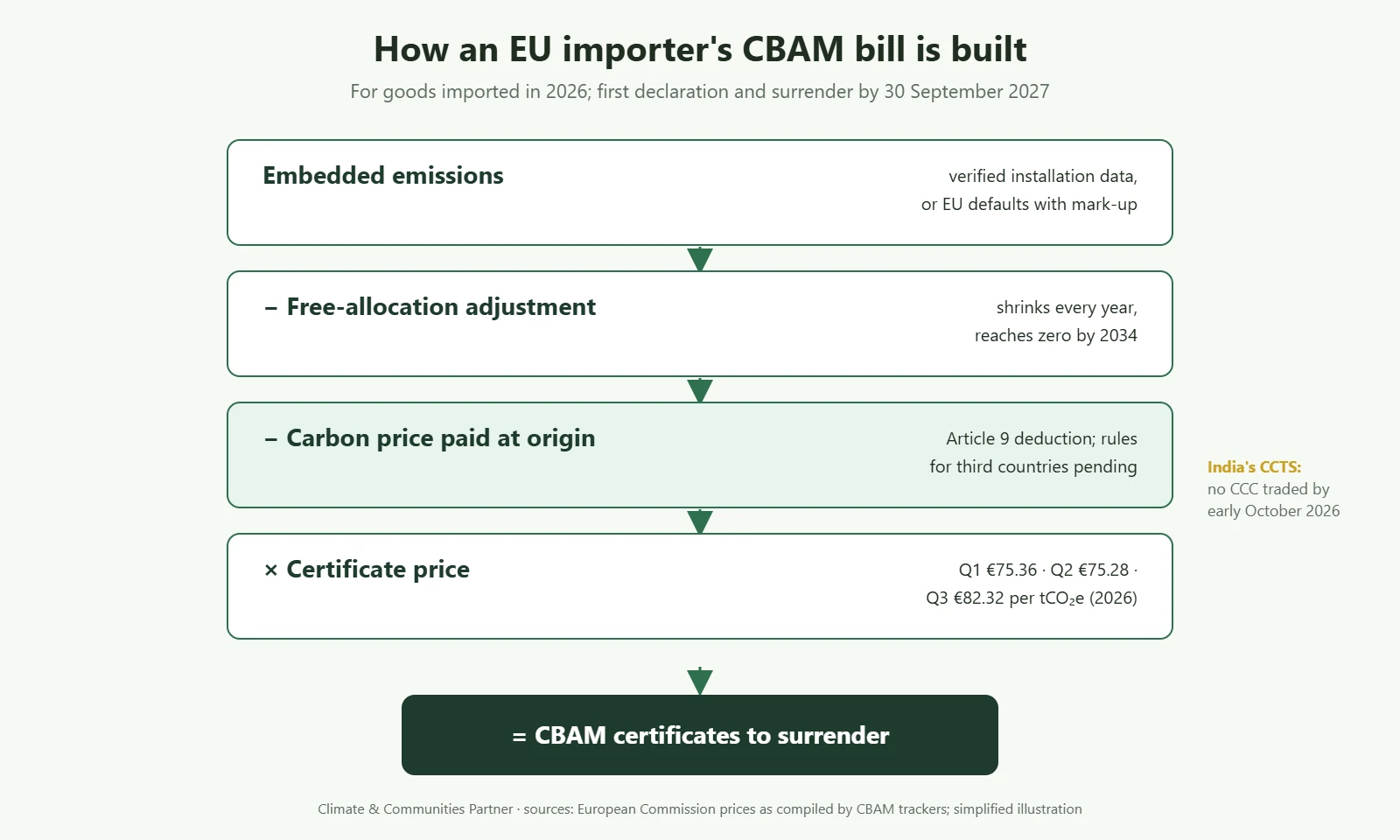
Three numbers that drive the bill
- Embedded emissions. Verified, installation-level data from the producer, or EU default values if no data is supplied. Default values include a mark-up that rises each year to 2028, so missing data is expensive.
- The free-allocation adjustment. Certificates owed are reduced to reflect free allocation still given to EU producers. That adjustment shrinks each year and disappears by 2034, so the effective cost rises over time.
- Carbon price already paid. CBAM allows a deduction for a carbon price effectively paid in the country of production. The detailed rules for recognising third-country carbon prices were still pending in 2026.
Where India’s CCTS fits
India’s Carbon Credit Trading Scheme covers several of the same sectors — aluminium, cement and, in draft, iron and steel — but it is an intensity-based system and no Carbon Credit Certificate had traded by early October 2026. Without a price actually paid in India, there is nothing for an EU importer to deduct for 2026 imports. Whether, and how, purchases of CCCs could count as a carbon price paid will depend on the EU’s implementing rules and on how the Indian market develops.
What exporters should do now
- Measure at installation level. Verified emissions data is the single largest lever on a buyer’s CBAM cost, and buyers are already asking for it.
- Align CCTS and CBAM data. Obligated entities already produce verified emissions reports for the CCTS. Mapping those to CBAM’s boundaries avoids building two parallel systems.
- Treat decarbonisation as pricing. Lower embedded emissions translate directly into a lower CBAM bill for the EU buyer, and therefore into negotiating room on price.
- Keep evidence of any domestic carbon cost. If CCTS costs become deductible, documentation will be required.
Climate & Communities Partner advises industrial clients on emissions measurement, CCTS compliance and the interaction between India’s carbon market and international mechanisms.
Sources
- European Commission CBAM certificate prices, as compiled by Carra Globe and CBAM Guide
- Sovran Commodities – EU CBAM definitive regime 2026
- SourceSquid – CBAM for Indian steel exporters
- Climate Decode – CBAM has three prices, India’s CCTS none